Technology comparison
Camera AI vs Cloud AI vs Edge AI
Compare where video analytics run, which cameras they work with and how they are charged. TetherX uses analytics from supported cameras and recorders, includes native AI on TetherBox, and supports optional cloud verification.
TetherX: Built in the UK and Australia. Local representatives in Canada and India. EU, North America and APAC supported.
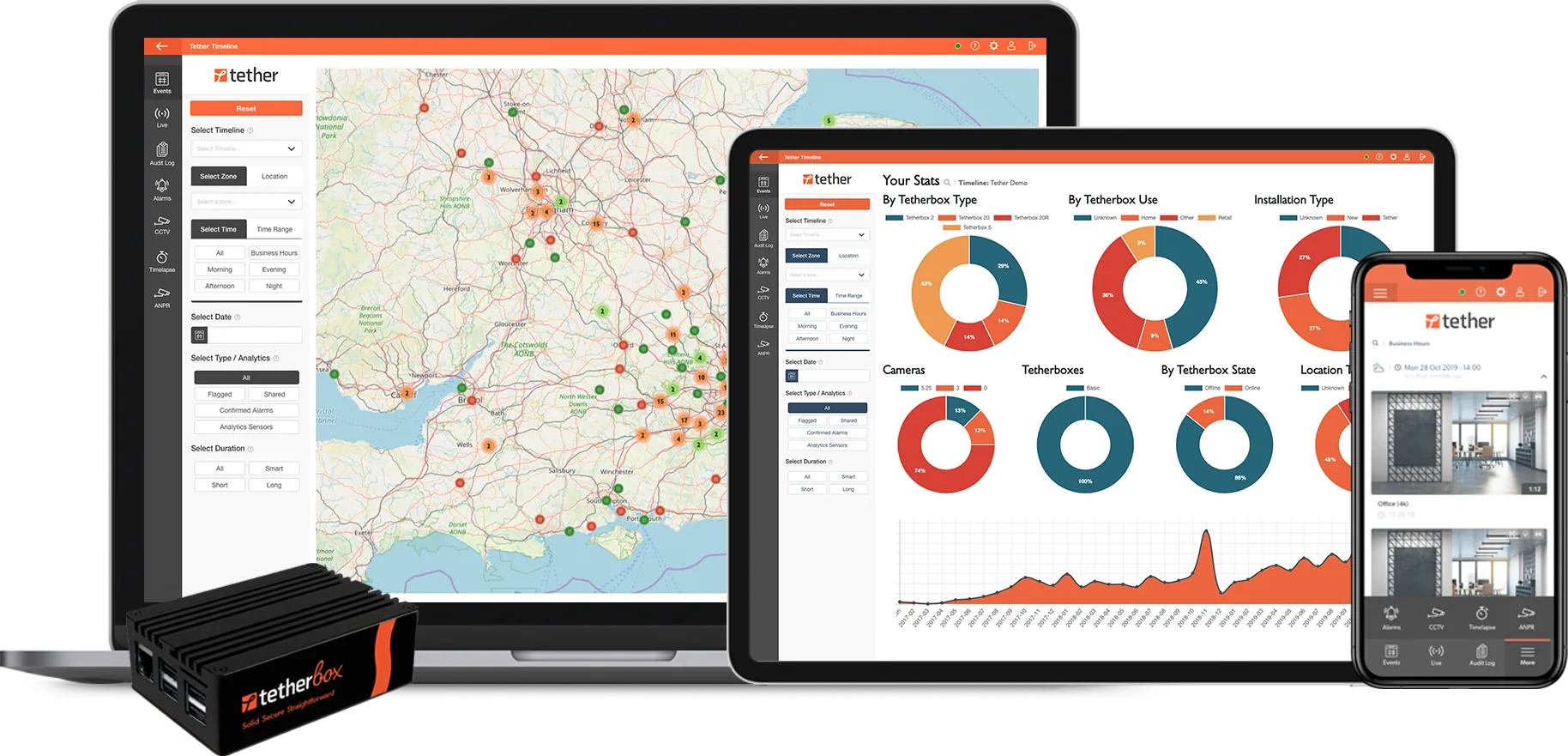
Four things to establish before anyone says the word again.
Every vendor in the category now sells AI, so the word has stopped narrowing a shortlist. These four questions still do.
Camera-side AI decides your next decade of purchases
When the classifier lives on camera silicon, the analytics brand and the camera brand are the same thing. Verkada, Rhombus and Avigilon all work this way, and it is genuinely efficient. It also means the purchase order signed in 2026 settled the fleet refresh in 2032. A camera from anyone else loses the AI, or gets a reduced version of it.
Cloud-side AI bills the uplink, every hour, at every site
A platform that classifies centrally has to receive the video first. Detection improves without anyone visiting a site, which is a real advantage, and the connection carries the cost continuously whether or not a person reviews the footage. On a thin rural line or a metered mobile backup, that link becomes the number deciding how many cameras a customer can afford to analyse at all.
The base licence is rarely what the AI costs
Videoloft prices smart motion, plate recognition, people counting and protective-equipment detection as four separate per-camera monthly lines. UniFi Protect leaves a third-party camera record-only until the site buys a $199 AI Port for it. HikCentral licenses AI search on top of the camera licence. Network Optix kept first-party AI out of the product until it reached the Enterprise tier in April 2026. Compare platforms on the detections the customer actually wants, across the cameras they actually have.
Some of it is motion detection wearing a new label
A real classifier names the object and lets an operator search for it afterwards. A rebadged motion detector draws a box around movement, calls it an event, and buries the night shift the first time it rains sideways. Ask the vendor to run their search on a camera you picked, against footage nobody curated, with weather in it.
Camera-side or cloud-only AI and TetherX, question by question
The 7 questions an integrator asks on a site walk, answered for both platforms.
| Question | Camera-side or cloud-only AI | TetherX |
|---|---|---|
| Do I need a recorder on site? | Camera-side platforms replace them, because the camera and the vendor cloud hold the video and an existing NVR has no role. Cloud-only platforms bridge them and treat the cloud as the canonical copy. | TetherX provides recording, viewing, search and monitoring through one system and one app. TetherBox records locally, with optional TetherX cloud recording, so no existing recorder or third-party cloud video service is required. It can also work alongside either where needed. |
| Which devices you can connect | Camera-side AI runs on that vendor's cameras. Everything else is bridged, record-only, or needs a paid appliance per camera to earn its analytics back. | 1,000+ integrations across 17,000+ device models, plus ONVIF and RTSP sources. Check model-specific recording, analytics and control support. |
| What gets sent over my internet connection? | Camera-side platforms stay light in steady state and push metadata and thumbnails. Cloud-side analytics need the video itself, continuously, from every camera being analysed. | Thumbnails, metadata and events, plus the clips an operator opens. Any camera your integrator sets to record to the cloud uploads on top of that; the rest record to the TetherBox alone, so a thin line still records every camera. |
| Where the AI runs | Strong, mature and genuinely good at the job, inside the fleet it was built for. The scope is the constraint rather than the quality. | Included TetherBox AI runs on the edge, and supported camera and third-party analytics feed the same timeline. Native video, appearance/PPE and counting run on compatible NVIDIA GPU/Jetson or Hailo compute, including Raspberry Pi AI HAT; audio runs locally on the CPU. Each module needs supported models, configuration and a capacity check. Additional modules and retention can cost extra. Optional paid Calipsa cloud verification is also available, and natural language footage search interprets requests in the cloud. |
| What you actually pay for | Frequently per analytic and per camera, above the platform licence. Plate recognition, people counting and protective-equipment detection commonly price separately from one another. | An annual platform subscription by channel count, from £100/site/year. TetherBox AI is included; additional modules and retention can cost extra. Cloud recording is optional; specialist analytics and professional monitoring are quoted separately. |
| Where your recordings are stored | In the vendor cloud, because that is where the analysis or the canonical recording happens. | Choose local and cloud retention per camera: mostly local, mostly cloud, or a mix. TetherBox provides on-site recording. Cloud recording is optional per camera, in a UK, EU, US, Canadian, Indian or Australian region the customer picks. |
| What you keep if you stop paying | On a camera-side platform the cameras stop working and the analytics go with them. On a cloud-only platform the recordings were never on site to keep. | The TetherBox keeps a local interface for live view and recent footage with no internet and no subscription, so the site is never dark. |
The Camera-side or cloud-only AI column is built from 4 public sources, listed at the foot of this page.
Same word. Three architectures. Different consequences.
All three approaches classify video accurately. What separates them is which cameras get analysed, what the connection has to carry, and who decides the next hardware purchase. The honest read on where each one wins and where each one costs you something.
Camera-side and cloud-side AI
Strengths
Analytics tuned against known sensors, which is why camera-side detection is accurate straight out of the box
Cloud-side models improve without anyone visiting a site or touching hardware
One vendor answers for the camera, the detection and the search, which makes a simpler purchase order
Trade-offs
Camera-side AI ties the analytics to the camera brand, so a mixed estate gets two search tools or a replacement programme
Cloud-side AI needs the video uploaded continuously, which prices the analysis by the connection rather than by the camera
Edge AI on the TetherBox
Strengths
TetherX AI video and audio detection run on suitable TetherBox hardware at the site, across supported camera brands
Natural language search interprets the request in the cloud, with a filter preview and editable date range before applying it
Support configures directional counting and people-region rules on compatible AI hardware; cloud notifications and output commands need connectivity
Recording stays local by default with cloud recording optional per camera, so a thin line never caps how many cameras are covered
Detection improves by changing one box per site rather than replacing a camera fleet
Trade-offs
You are buying a whole new estate, with the cameras and the analytics on one purchase order. A camera-side platform is the simpler buy.
Run your control room. Or connect the ARC you already use.
TetherX supplies operator queues, verification, escalation, recorded outcomes and performance reporting within its cloud platform. Work the alarms in TetherX, or forward them into a supported monitoring platform.
First-party TetherX integration connects to Intelligent Monitoring Solutions (IMS) through Patriot, with alarm images and confirmed alarm delivery. IMS lists 800+ bureaus and two A1/R1A centres. Explore TetherX control-room workflows · IMS provider information
Other security platforms also provide operator alarm handling and monitoring integrations. Compare the supplied workflow, equipment support, licence and monitoring contract for your proposal.
AI and recording terms: TetherBox AI is included in the platform subscription. Additional modules and data retention may cost extra. Cloud recording is optional; specialist services and professional monitoring are separately scoped. See current AI coverage.
Pricing figures, ownership, acquisition dates and product behaviour cited on this page are point-in-time and drawn from public sources - see the disclaimer at the bottom of this page for sourcing, "as of" date, and how to flag corrections.
Pick the one your site points at
Find the column that describes the job in front of you.
Choose a camera-side AI platform if
- The site is new-build with no cameras to keep, so buying the camera and the analytics together strands nothing
- One vendor holding the whole stack is worth more to this buyer than choosing cameras freely later
- Every site has bandwidth to spare and continuous upload costs the customer nothing
- The detections needed are exactly the ones that vendor ships, and will still be in five years
Choose TetherX if
- Cameras are already on the wall from more than one manufacturer and replacing them is not in the budget
- The customer wants one search across the whole estate rather than one per camera brand
- Sites have thin or metered connectivity, so analysing video in a distant data centre is not realistic
- Detection types will change over the life of the system and you would rather upgrade a box than a fleet
Give every vendor the same tasks
Use representative cameras and a realistic incident, and ask the people who will run the system to do the work themselves.
- Find the footage of a realistic incident by place and time.
- Follow the person or vehicle across several cameras.
- Bookmark the moment and share a clip, then check the recipient can open it.
- Add a user who should see only their own sites.
- Check system health across every site from one screen.
- Pull the network cable. Note what keeps recording, what you can still watch on site, and what catches up when the link returns.
- Test one integration you rely on, such as an alarm panel, door or sensor. A video feed of another system on screen is not the same as the data behind it: check its events arrive on the timeline, where you can search them and act on them.
Start with the cameras you have. Send us your camera list, through your installer or distributor if you have one, and we'll tell you which models are supported, which features each keeps, and whether anything needs replacing.
See these tasks in a TetherX walkthrough, then run them at one of your sites with a 30-day trial through an installer partner.
Questions on AI video management
An AI VMS is a video management system that classifies what it sees, rather than only detecting that pixels changed. Instead of a motion alert every time a tree moves, the platform reports a person, a vehicle, a number plate or a missing hard hat, and lets an operator search recorded footage for those things directly.
Almost every VMS on the market now carries the label, which makes it close to useless as a filter. The useful questions are narrower: where does the detection run, which cameras get it, what does each analytic cost, and does the search cover the whole estate or only the part that came from one manufacturer.
There are three places, and the choice decides more about the next decade than the feature list does.
On the camera. The analytics live on silicon inside the camera, which is efficient and accurate. It also makes the camera brand the analytics brand. Verkada, Rhombus and Avigilon Alta all work this way, so a camera from anyone else loses the AI or gets a reduced version of it.
In the cloud. The platform uploads video and classifies it centrally. Detection improves without anyone touching site hardware, and the uplink carries the cost continuously, at every site, whether or not a person ever reviews the footage.
At the edge, on a box. A device on the local network reads every camera it can reach and runs detection there. The cameras stay whatever they already are, the uplink carries thumbnails and the clips someone opens, and you upgrade detection by changing one box rather than a fleet. TetherX AI video and audio detection run here, on suitable TetherBox hardware.
Natural language footage search uses the cloud to turn your description into search filters. Describe a person, vehicle, place or time, review the preview and apply the search across your sites.
Yes. TetherX AI video and audio detection run on suitable TetherBox hardware on the local network. Supported camera feeds provide detections for search, alerts and the control-room workflow. Natural language search interprets your request in the cloud and lets you review the selected event filters before applying them. The TetherX AI page lists what it detects.
The platform keeps evolving with additional analytics through the year.
Because a detection type is easy to meter and easy to withhold, which makes it a dependable upgrade path. The shapes repeat across the category.
Videoloft prices smart motion, plate recognition, people counting and protective-equipment detection as four separate per-camera monthly add-ons. UniFi Protect treats a third-party camera as record-only unless the site buys a $199 AI Port for it. HikCentral licenses AI search as its own line on top of the camera licence. Network Optix kept first-party AI out of the product until Nx AI Manager arrived at the Enterprise tier on 28 April 2026. Genetec sells analytics as licensed modules above the base platform.
None of that is dishonest, and every vendor will explain the logic. It does mean a quote comparing platforms on the base licence compares the wrong number, and a customer who wants three detection types across forty cameras should price all three before choosing.
Ask what happens on a camera the vendor did not sell you, then ask to watch it fail.
A genuine classifier names the object and lets you search for it afterwards: show me every red vehicle at the loading bay last Tuesday. A rebadged motion detector draws a box around movement, calls it an event, and buries the night shift the first time it rains sideways. The quickest test is to run the vendor's search against footage nobody curated, on a camera you picked, with weather in it.
The second question is scope. If the search only returns results from cameras that vendor manufactured, it is a camera feature rather than a platform feature, and a mixed estate ends up with two search tools instead of one.
It is the biggest operational change of the three, which is why monitoring centres buy filtering separately when their platform does not include it. Immix centres pay third-party cloud AI to classify alerts arriving from site as bare snapshots, and CHeKT built a partner network around the same gap.
TetherX publishes 90% as the reduction it delivers, and the mechanism is simply that a classified event can be discarded before an operator ever sees it. The honest caveat is that no classifier is perfect, and a badly-aimed camera still needs somebody to go and aim it properly.
On an edge platform, yes, and that is the practical argument for one. TetherX supports 1,000+ integrations across 17,000+ device models plus any ONVIF camera at full feature, and the analytics run on the TetherBox rather than in the camera, so an ageing fleet gets modern search without being replaced.
On a camera-side platform the answer is usually no, or not fully. Establish that early, because a proposal quietly assuming a fleet replacement is a different project from the one the customer thinks they are buying.
Wherever the site needs them, which is the point of separating the two decisions. The TetherBox records locally by default, so recording carries on through an outage and a thin line never limits how many cameras are covered. cloud recording is then optional per camera, into a UK, EU, US, Canadian, Indian or Australian region the customer picks.
A customer can put the car park in the cloud, keep the shop floor local, and change their mind later without buying anything again. The cloud VMS buyer's guide covers the retention side in more detail.
Yes. A 30-day free trial through an integrator partner with a TetherBox, full platform access including AI search, running against the cameras already on the site so you judge the detection on real footage rather than a demo reel. Extensions on request.
Free comparison PDF
Not ready to talk? Take the comparison with you.
A one-page open cloud VMS versus locked-platform breakdown: what you keep, what you cut, what it costs. We will email it over, usually the same working day.
No sales call; your details stay with us. We route serious enquiries through accredited local TetherX installers.
Want this at your site?
Get a quote from a certified TetherX installer. We will match you with a local partner who knows your area and your needs.

Want the shortlist rather than the theory? The best VSaaS providers page ranks the platforms, and the cloud VMS buyer's guide covers retention and pricing.
Try TetherX free for 30 days
Run TetherX AI against the cameras already on a real site and judge the detection on your own footage. 30 days, extensions on request.
Start Free TrialAcross the partner network
TetherX partners hold the accreditations security-procurement buyers and insurers filter on. Coverage varies by partner.
Counts reflect partners currently in the TetherX directory holding each accreditation.
References (4 public sources)
Anything wrong on the Camera-side or cloud-only AI comparison?
Flag an inaccuracy, an outdated fact, or a missing nuance on the Camera-side or cloud-only AI page. We update the per-vendor pages and the /compare hub from this inbox - real reply, real human.
[1] About this comparison. Information about other vendors is drawn from their public product pages, datasheets, integrator forums (Reddit, vendor user groups), public CVE databases (NVD, CISA), publicly-listed LinkedIn company pages (headcount, headquarters, founding year, leadership transitions and corporate ownership signals) and customer conversations - accurate to the best of our knowledge as of Q3 2026. Pricing, features, security posture and policies change. A vendor may have shipped a fix, dropped a price, added a region or changed an architecture since this page was last reviewed.
If you believe anything here is inaccurate or out of date, please contact us and we will review and correct it. Trademarks and product names belong to their respective owners and are referenced here for identification only.
30 days free. No card. Talk to a local installer.
