Compliance and ringfencing
Compliant cloud VMS for restricted-equipment sites.
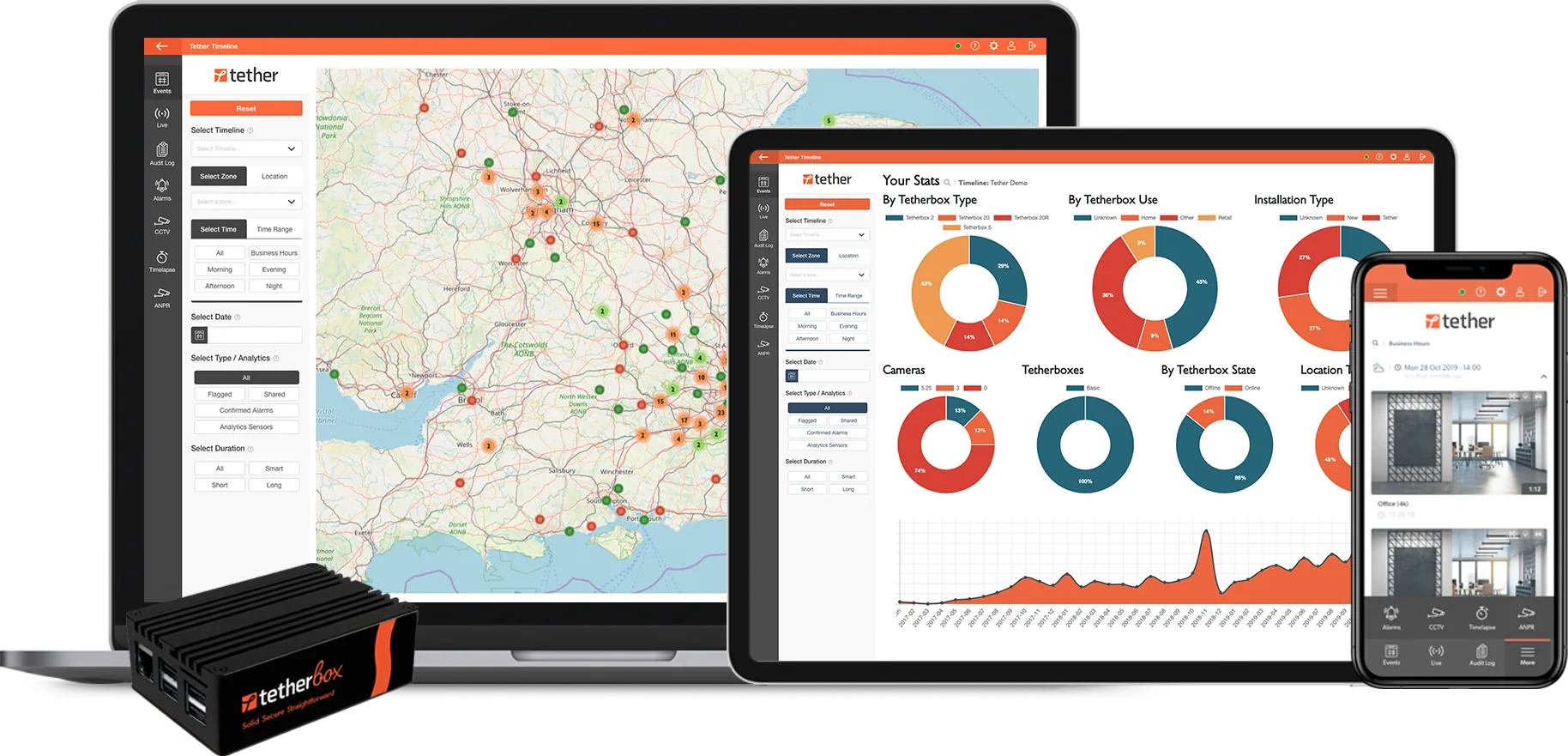
The US, UK, EU, Australia and Canada are all moving the same way: restricted surveillance equipment has to stay off the public Internet, and someone has to be able to prove who touched it and when. TetherBox is built around that. Cameras sit on the site network behind it, the TetherBox is the only thing that talks to the cloud, and every action is logged. Existing kit stays where the rules allow; over 12 to 36 months it swaps out for Hanwha Vision, Axis, Avigilon, Pelco, Bosch where they require it.
Built in the UK and Australia. Local representatives in Canada and India. EU, North America and APAC supported.
One camera. Whole contract.
Section 889 doesn't care which contract the equipment sits on - if any part of the contractor's estate uses covered kit, the federal relationship is at risk. Other governments are heading the same way. The UK (2022 Cabinet Office statement) and Australia (2023 Defence removal) already have their own restrictions; India, the Netherlands and Taiwan are following. State and local authorities receiving federal money tend to inherit whatever Washington decides.
Federal agencies
FBI, Coast Guard, military, VA, National Park Service, every federal executive agency. No exemptions, no transitional grace.
Federal prime contractors
The blacklist clause covers any contractor that uses covered equipment - on the federal job or elsewhere. Foreign offices count.
Federal-funding recipients
State and local agencies receiving federal dollars (schools, transit, utilities, courts) inherit the restriction.
Country-level expansion
UK (Cabinet Office, 2022) and Australia (Defence, 2023) have introduced their own Hikvision / Dahua restrictions, with India, the Netherlands and Taiwan following. The trend is one-way.
Different governments. Same problem.
Most Western governments have written their own version of the NDAA Section 889 rule for Hikvision, Dahua and related Chinese-state surveillance vendors. The wording is different in each country, but the buyer's job is the same - and so is the TetherX migration path.
United States
Policy. NDAA Section 889 of the 2019 National Defense Authorization Act. Procurement ban effective August 2019; broader blacklist on use of covered equipment effective August 2020.
Scope. Every federal executive agency, every federal prime contractor and every federal-funding recipient. No geographic carve-outs - a foreign office using a single Hikvision camera puts the parent contract at risk. State and local authorities receiving federal dollars (schools, transit, utilities) inherit the restriction.
Brands. Hikvision, Dahua, Huawei, Hytera and ZTE - plus any subsidiary, affiliate or OEM-rebadged variant.
United Kingdom
Policy. Cabinet Office written statement HCWS386 (Oliver Dowden, 24 November 2022).
Scope. Departments instructed to stop deploying surveillance equipment from companies subject to China's National Intelligence Law on sensitive government sites, to disconnect existing kit from departmental core networks, and to consider extending the same controls beyond sensitive sites.
Brands. Not named in the statement, but the National Intelligence Law trigger captures Hikvision and Dahua. NPSA guidance operationalises against those vendors.
European Union
Policy. European Parliament 2023 motion to remove Hikvision cameras from its premises. NIS2 directive (transposed October 2024) requires essential and important entities to manage supply-chain risk from high-risk suppliers. Czech Republic NUKIB cybersecurity warning on Hikvision and Dahua (2024).
Scope. No single EU-wide statute equivalent to Section 889 - a patchwork of EU-institution policy, NIS2 supply-chain duty-of-care and national-level bans (Lithuania, Estonia, Czech Republic). Procurement teams treat the stack as functionally equivalent.
Brands. Hikvision named in the European Parliament debate; Dahua under the same NIS2 supply-chain risk umbrella.
Australia
Policy. Defence Minister Richard Marles, 9 February 2023, following the Paterson audit (913 devices across 250+ federal premises).
Scope. Defence Department ordered to remove Chinese-made cameras from buildings; broader removal commitments across Attorney-General's, Climate Change & Energy, Social Services and other federal departments. Ministerial direction rather than statute. The Australian War Memorial began removal in parallel.
Brands. Hikvision and Dahua explicitly named.
Canada
Policy. Federal procurement ban official 2025 - Treasury Board Secretariat and Public Services and Procurement Canada delisting of Hikvision. Canadian Centre for Cyber Security (CCCS) advisories on Chinese-state surveillance vendors.
Scope. Federal procurement and federally-funded provincial / municipal projects. Mirrors US Section 889 in spirit. CCCS supply-chain guidance applies to broader critical-infrastructure deployments.
Brands. Hikvision delisted from federal procurement; Dahua under the same supply-chain risk umbrella.
India (MeitY "Essential Requirements for CCTV cameras" 2024 + STQC certification regime mandatory from April 2026), the Netherlands (2023 parliamentary motion to phase out Hikvision and Dahua at sensitive sites) and Taiwan (long-standing ban on Chinese-state vendors in government procurement) have their own equivalents. The migration playbook below applies to all of them.
Compliant in months, not years.
Camera replacement is the slow and expensive part. The trick is to sequence it - get the management software off the covered list straight away, then phase the cameras over time.
Audit the estate
TetherX dashboard inventories every connected camera with manufacturer, model, firmware. Use it to answer the Section 889 "reasonable inquiry" requirement instead of spreadsheets and site visits.
Replace the VMS layer
Install a TetherBox at each site (TetherBox software on an existing server or PC, or a dedicated unit from the range - see the range). The existing Hikvision / Dahua cameras stay on the site network behind it - the TetherBox is the only path to the cloud, the cameras have no direct Internet access. Decommission HikCentral Pro / DSS Pro servers. The management layer is now NDAA-friendly.
Phase cameras 12-36 months
As warranty, end-of-life and budget allow, swap cameras for Hanwha, Axis, Avigilon, Pelco or Bosch. From the operator's seat nothing changes - same dashboard, same workflows, new compliant hardware underneath.
Evidence compliance
Export the camera-by-camera manifest at any time. ISO 27001 / SOC 2 certified cloud infrastructure, audit log, certificate-based encryption. Document the migration end to end.
TetherX works with every NDAA-friendly brand worth installing.
Pick the camera that fits each site. Specify NDAA-compliant where you must, mix in your preferred hardware elsewhere. TetherX is the constant.
Hanwha Vision
Wisenet line, deep TetherX integration, Korean-built NDAA replacement of choice.
Axis Communications
Swedish, ONVIF-native, the most-installed enterprise camera brand outside Hikvision.
Avigilon (Motorola)
Mercury controllers, non-proprietary, multi-vertical US enterprise install base.
Pelco
Long-standing US brand, public-sector and transport-vertical heritage.
Bosch
European enterprise, on-camera Intelligent Video Analytics, deep BVMS heritage.
i-PRO (formerly Panasonic)
Japanese, low-light specialist, broad ONVIF compatibility.
Section 889 questions answered
Compliance is shared. TetherX provides the platform tooling (regional storage, encryption, role-based access, audit logging, ringfencing and an NDAA-friendly camera path). The operator and integrator are responsible for selecting approved cameras for every position, setting retention, limiting admin access and running the policy. See the shared-responsibility FAQ.
Still have questions about compliance, supported cameras or the migration timeline?
Read the full FAQGet on the NDAA migration path
Run TetherX next to your existing Hikvision / Dahua install. Compliant management layer on day one, camera replacement on your schedule.
Start Free Trial[1] About this comparison. Information about other vendors is drawn from their public product pages, datasheets, integrator forums (Reddit, vendor user groups), public CVE databases (NVD, CISA), publicly-listed LinkedIn company pages (headcount, headquarters, founding year, leadership transitions and corporate ownership signals) and customer conversations - accurate to the best of our knowledge as of Q3 2026. Pricing, features, security posture and policies change. A vendor may have shipped a fix, dropped a price, added a region or changed an architecture since this page was last reviewed.
If you believe anything here is inaccurate or out of date, please contact us and we will review and correct it. Trademarks and product names belong to their respective owners and are referenced here for identification only.
