WHERE SENSTAR CONSTRAINS

Perimeter-first, VMS second.

The VMS is there to serve the fence

Symphony is at its best wired to Senstar fencing, microwave, fibre and buried-cable sensors, which is exactly what you want on a prison perimeter or a tank farm. On a site that does not need perimeter-detection physics, the video half competes on its own against platforms built for nothing else. Senstar sets the product strategy from the sensor portfolio rather than from the VMS.

Nothing in the product ringfences the cameras

Symphony ships no edge gateway, so keeping the Windows VMS and the cameras off the open Internet is a job for whoever runs the site network. It gets done well on a defence site with a network team and forgotten on a depot without one. Two published bugs show what that surface costs: ZDI-20-1080 in August 2020 allowed arbitrary code execution through the SSOAuth login endpoint, and ZDI-25-1060 in December 2025 leaked information from the licence-fetch endpoint. Both were patched, and both were reachable because the server was.

The channel is perimeter specialists, not security installers

Senstar sells through the people who install buried cable and fence sensors, which is the right channel for the flagship products and a narrow one for a VMS. A mid-market commercial installer rarely leads with Symphony, so a customer who moves away from perimeter detection often finds nobody nearby who knows the platform.

AT A GLANCE

Senstar Symphony and TetherX, question by question

The 7 questions an integrator asks on a site walk, answered for both platforms.

Question Senstar Symphony TetherX
What you do with the recorders already on site Symphony records on an on-premise Windows server, on architecture inherited from the Aimetis acquisition. Multi-server and high availability are Enterprise-edition features. They stay. The TetherBox sits alongside the existing NVRs, DVRs and panels and pulls from them. It runs as software on a server the site already owns, so nobody rips out working kit to start.
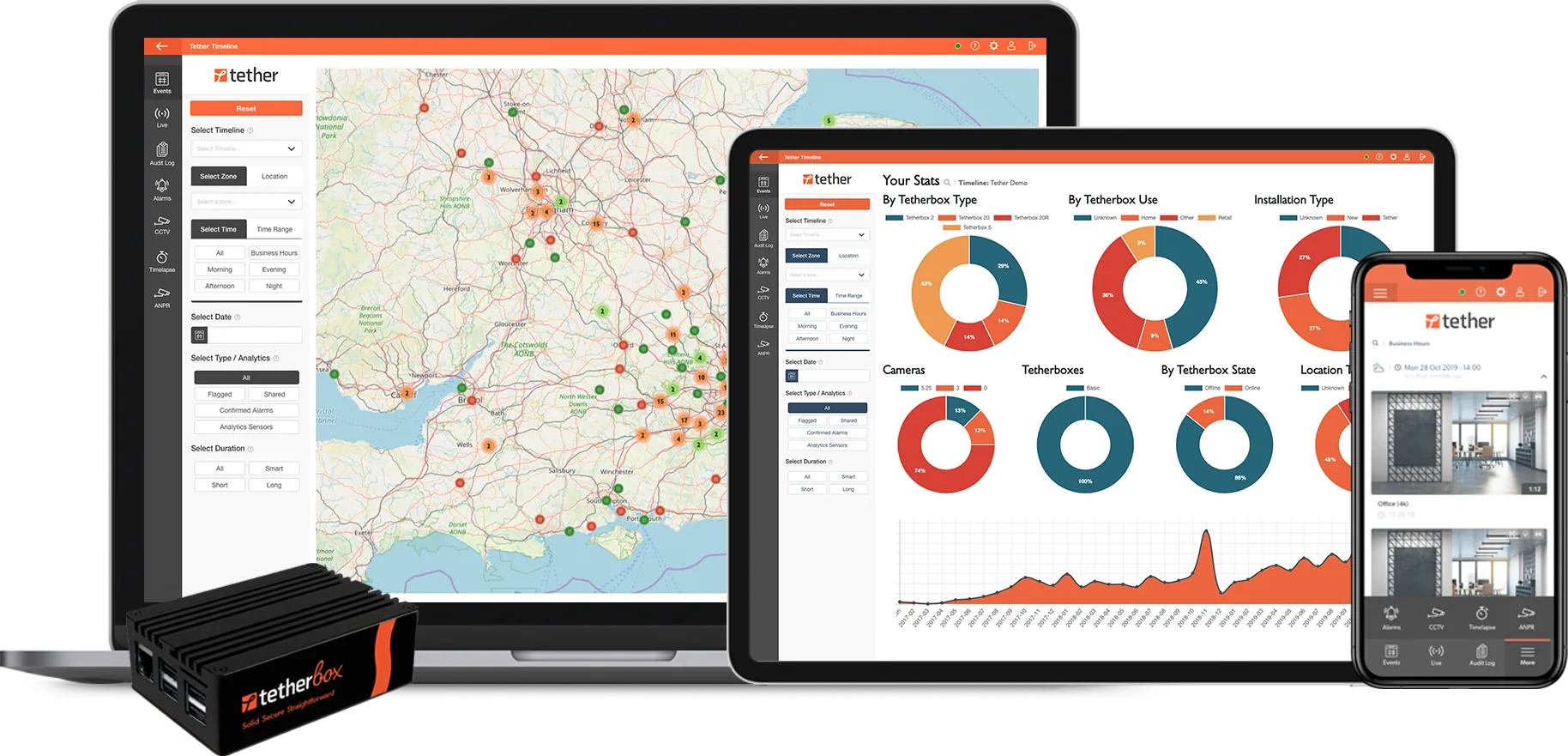
What your operators see on one timeline Video alongside Senstar perimeter detection - fence sensors, microwave, fibre and buried cable - which is the genuine differentiator and the reason the platform exists. Video, access control, intruder and automation. One operator, one timeline, one dashboard across all four.
What your uplink has to carry Whatever remote access the site network team builds. There is no edge gateway in the product, so ringfencing is an operations job rather than part of the architecture. Thumbnails, metadata, and the clips an operator opens or chooses to sync. A thin rural line still records every camera, because recording never leaves the local network.
Where the AI runs Symphony video analytics, strongest where they corroborate a perimeter sensor rather than standing alone. At the edge on the TetherBox: person, vehicle and animal detection plus 63-class audio analytics, searchable across multi-site footage in seconds. The platform keeps evolving with additional analytics through the year.
Who you buy it from Through perimeter-detection specialists rather than the broad security-installer channel. Your installer, always. TetherX sells through the channel only and does not quote end customers direct, so the integrator keeps the account.
What you actually pay for Per-device licensing on an edition ladder, with multi-server and high availability reserved for Enterprise. An annual subscription by channel count, from £100/site/year. Not per operator seat, not per analytic, and no concurrent-user cap.
What you keep if you stop paying The licences keep running on the server. The perimeter sensors are Senstar hardware and stay Senstar hardware, so the fence is the part that is hard to leave. The TetherBox keeps a local interface for live view and recent footage with no Internet and no subscription, so the site is never dark.

Senstar Symphony column built from: Senstar Symphony, ZDI-25-1060 advisory.

SENSTAR vs TETHERX

Perimeter-bundle VMS vs cloud-native VMS.

Both serve critical-infrastructure-aware deployments. The honest read on where each one wins and where each one costs you something.

Senstar Symphony

Strengths

44 years of perimeter intrusion detection heritage - fence, microwave, fibre and buried-cable sensors purpose-built for critical infrastructure, corrections and utilities

Sensor-fusion architecture - Symphony lights up most strongly when bundled with Senstar perimeter hardware

NASDAQ-listed (SNT) public company - financial transparency for risk-conscious procurement

Trade-offs

On-premise Windows-server VMS inherited from the 2016 Aimetis acquisition - no cloud-native SaaS at parity with Verkada / Eagle Eye / Brivo / Genetec SaaS

Two published CVEs (ZDI-20-1080 remote code execution, ZDI-25-1060 information disclosure) - both patched, but the Windows-exposed VMS surface area is the reason they were reachable

TetherX

Strengths

Cloud-native architecture - no Windows server tax, no manual patching

TetherBox at every site ringfences cameras from the Internet over an outbound-only encrypted tunnel - architecture, not site-team operations work

Cloud recording optional per camera - local-only, cloud-only or both, all in one platform

Trade-offs

You are protecting a prison, a substation or a utility compound, and you want fence, microwave, fibre and buried cable in the same product as the video. Symphony is the deeper perimeter buy.

Pricing figures, ownership, acquisition dates and product behaviour cited on this page are point-in-time and drawn from public sources - see the disclaimer at the bottom of this page for sourcing, "as of" date, and how to flag corrections.

WHICH ONE FITS

Pick the one your site points at

Find the column that describes the job in front of you.

Choose Senstar Symphony if

  • The site has a real perimeter to defend and fence, microwave, fibre or buried-cable detection is central to the design
  • A perimeter specialist is already on the account and will maintain the sensors for years
  • Policy forbids cloud and the customer has staff to run and patch a Windows server
  • Corroborating a sensor hit with the nearest camera is the primary operator workflow

Choose TetherX if

  • The perimeter sensors matter but you want them on a timeline that also carries doors, intruder and every camera on site
  • Nobody local supports the platform and the customer needs an installer who is reachable
  • The cameras and the video server should not be exposed to the Internet by whoever last configured the router
  • You are supporting many commercial sites rather than a handful of high-security ones
FAQ

Questions before you switch from Senstar Symphony

Senstar Technologies (NASDAQ: SNT) is an Ottawa-headquartered perimeter-intrusion detection (PIDS) specialist - fence-mounted, buried-cable, microwave and fibre-optic sensors with a 45-year pedigree (Sentrax, 1981). Magal Security Systems divested its projects division in June 2021 for around US$35M and renamed the residual public company Senstar Technologies, its existing wholly-owned subsidiary. It then redomiciled from Israel to Ontario, Canada, effective 18 March 2024. The VMS, Symphony, came in via the April 2016 Aimetis acquisition (Waterloo, Ontario; ~US$14M enterprise value) and remains a Windows-server VMS attached to the perimeter-detection portfolio. That bundle is a genuine fit for airports, prisons, substations, military bases and other PIDS-led critical-infrastructure deals - we are not arguing against Senstar there.

For a typical multi-site commercial installer without a perimeter-sensor requirement, the same stack lands as a niche enterprise tool. Two further frictions for that buyer: two ZDI (Zero Day Initiative - Trend Micro's security-bug bounty programme) advisories against Symphony (ZDI-20-1080, August 2020, a critical bug that let an attacker run arbitrary code over the SSOAuth login endpoint; and ZDI-25-1060, December 2025, an information-disclosure bug in the licence-fetch endpoint) - both patched - and no cloud-native SaaS offering at parity with Verkada, Eagle Eye / Brivo or Genetec SaaS. TetherX is the cloud-native, installer-friendly alternative for that profile of buyer: TetherBox at every site, no Windows server, cloud recording optional, perimeter detection consumed from whatever sensor vendor the customer already runs.

TetherX connects to perimeter and intrusion sensors via alarm-panel integration (Texecom, Hikvision AX Pro, IP-communicator alarm protocols like SIA DC-09 and Contact ID), so any Senstar fencing, microwave or fibre sensor that feeds an alarm panel triggers the camera and the ARC integration (Alarm Receiving Centre) workflow the same as any other alarm zone.

For specialist perimeter analytics on the camera image itself (line-cross, perimeter intrusion detection), AI search covers the common cases. For deep perimeter-detection physics (cable-borne vibration, fence disturbance, microwave beam-break, buried-cable volumetric) Senstar sensors stay in place and feed TetherX over the alarm channel - we do not try to replace the perimeter-sensor hardware.

Senstar Symphony is sold as a Windows-server VMS with per-channel licences, typically through specialist perimeter-detection resellers. The FY24 Senstar Technologies (NASDAQ: SNT) 10-K implies roughly US$1,440 ARPU per deployment per year across the 25,000+ installation base - one of the cleanest public-company VSaaS-adjacent benchmarks available. Reseller pages list Symphony Enterprise V7 around US$499 per device (DCAmericas, B&H, A2Z), with the perimeter-sensor stack on top for sensor-led deals.

TetherX is an annual platform subscription priced by channel count (from £100/site/year) through your installer partner, with cloud recording, AI search and ARC integration as optional per-camera services - no Windows server tax, no perimeter-vendor bundle.

Yes, on the patched version, behind a ringfence, not directly on the Internet. Senstar published patches for both bug reports (ZDI-20-1080 in August 2020 and ZDI-25-1060 in December 2025). Symphony servers exposed to the Internet were the worst case; servers on isolated private network segments with no inbound Internet access were not exploitable from the public side.

Standard advice for any VMS, not just Senstar: patch promptly, ringfence the recording server from the Internet, restrict admin access to named users on a separate management network. That is the architecture TetherX delivers by default via the TetherBox gateway - cameras and recording server sit behind an outbound-only tunnel, never reachable from the public Internet, regardless of which VMS is running.

Yes. Symphony supports ONVIF (the open camera standard) and a long camera list inherited from the Aimetis era. TetherX supports 1,000+ integrations and any ONVIF device - the overlap is essentially complete for cameras installers actually deploy. The cameras stay; only the recording server and the VMS change.

When the deal is sensor-led: airport perimeters, prison fences, substation compounds, military bases, government estates. The buyer wants one vendor supplying the fence-line sensors (FlexZone, OmniTrax, FiberPatrol, LM100), the cameras and the VMS together. Senstar's sensor-fusion engine pre-correlates perimeter events with video, which beats gluing Senstar sensors into a third-party VMS through a developer toolkit.

If the primary requirement is multi-site cloud video across a commercial estate - retail, healthcare, logistics, housing, education - and there is no fence-line perimeter detection in scope, the calculation flips: a cloud-native TetherX deployment is the lower-friction architecture, with Senstar sensors available as an alarm-panel-integrated input if a perimeter site later joins the estate.

Yes. 30-day free trial through an integrator partner with a TetherBox, full platform access. Extensions on request.
COMPANY HISTORY

Senstar: 44 years of perimeter detection, Aimetis-acquired VMS sideline

Senstar (originally Sentrax) was founded in Ottawa in 1981 as a perimeter intrusion detection specialist for critical infrastructure, corrections and utilities. The company is NASDAQ-listed as SNT (Senstar Technologies, ~US$3.04/share May 2026).

The VMS sideline came from the 2016 acquisition of Aimetis, the Canadian video analytics and VMS vendor. Aimetis Symphony was rebranded Senstar Symphony and primarily exists to give Senstar's fence sensors a unified pane of glass. Not a horizontal VMS competitor - the sales motion is critical-infrastructure / corrections / utilities deals where the buyer wants perimeter PIDS (perimeter intrusion detection system) + VMS from one vendor.

17 February 2026: Senstar closed its acquisition of Blickfeld GmbH (German solid-state LiDAR sensors). The strategic direction is more perimeter-detection breadth, not horizontal VMS expansion. Symphony continues on perpetual-licence + annual-maintenance commercials. The manufacturer's site is the authoritative source for current product status.


Free comparison PDF

Not ready to talk? Take the comparison with you.

A one-page open cloud VMS versus locked-platform breakdown: what you keep, what you cut, what it costs. We will email it over, usually the same working day.

Please complete the verification.

No sales call; your details stay with us. We route serious enquiries through accredited local TetherX installers.

Want this at your site?

Get a quote from a certified TetherX installer. We will match you with a local partner who knows your area and your needs.

Certified Installers
Local to You
No Obligation
Prefer to browse partners first? See our partner directory →

Still have questions about perimeter integration, migration or licensing?

Try TetherX free for 30 days

Run TetherX alongside an existing Senstar Symphony install. Trial extensions on request.

Start Free Trial

Across the partner network

TetherX partners hold the accreditations security-procurement buyers and insurers filter on. Coverage varies by partner.

NSI 9 ISO 9001 7 SSAIB 5 SafeContractor 5 BAFE 4 CHAS 4 ConstructionLine 4 Cyber Essentials 3 NICEIC 2 ISO 14001 2 ISO 27001 1

Counts reflect partners currently in the TetherX directory holding each accreditation.

Anything wrong on the Senstar Symphony comparison?

Flag an inaccuracy, an outdated fact, or a missing nuance on the Senstar Symphony page. We update the per-vendor pages and the /compare hub from this inbox - real reply, real human.

Please tell us what to call you.
Please enter your email address.
Please tell us what to fix or add.
Please complete the verification.

We reply within 1 business day. No newsletter, no follow-up sequence.

[1] About this comparison. Information about other vendors is drawn from their public product pages, datasheets, integrator forums (Reddit, vendor user groups), public CVE databases (NVD, CISA), publicly-listed LinkedIn company pages (headcount, headquarters, founding year, leadership transitions and corporate ownership signals) and customer conversations - accurate to the best of our knowledge as of Q2 2026. Pricing, features, security posture and policies change. A vendor may have shipped a fix, dropped a price, added a region or changed an architecture since this page was last reviewed.

If you believe anything here is inaccurate or out of date, please contact us and we will review and correct it. Trademarks and product names belong to their respective owners and are referenced here for identification only.

30 days free. No card. Talk to a local installer.