WHERE EAGLE EYE / BRIVO COSTS YOU

Premium pricing for a constrained model.

Six headlines drive most of the integrator complaints. Each is unpacked in the ten aspect-by-aspect tables further down the page.

Per-camera SKU stacking

$15-50/cam/mo base, and every camera is its own SKU - resolution band x retention period x contract term. LPR, 911 sharing, extended retention, storage and analytics bill as separate line items, so a 4K LPR cam on multi-year retention costs a multiple of a basic doorway cam - quoted off a near-thousand-SKU price list with no public pricing.

Proprietary Bridge / CMVR appliance

Eagle Eye Bridge or CMVR at every site - the only bridgeless option is fail-prone in-camera SD cards. Eagle Eye / Brivo SKU only, customer locked into the hardware refresh cycle.

Org features split across editions

Locations / Sites, Floor Plans and SSO are gated to the Professional / Enterprise editions. The installing integrator gets a reseller account under the Eagle Eye / Brivo brand - platform white-label is reserved for OEM partners like Hanwha and Mobotix.

Post-merger upheaval

Eagle Eye + Brivo merged on 29 December 2025 (now branded Brivo). Ken Francis (long-time EEN President) pushed out September 2024 ahead of the deal; around 30-40 sales-team layoffs the day the merger closed. Glassdoor consistently sits below 3/5 and below 40% recommend - well under the IT-industry average.

Quote-only pricing through Brivo sales

Every pricing conversation now routes through a Brivo sales quote. IPVM has confirmed a 2025-2026 climb in headline pricing. Bundle creation (Brivo Access + Eagle Eye Video) is the new dominant pricing dynamic, which IPVM flags as "Open Conflict" with the open-ecosystem messaging.

Three separate mobile apps

Viewer (4.2/5), Smartphone Camera and CameraManager - end customers regularly install the wrong one.

EAGLE EYE / BRIVO vs TETHERX

Two cloud-native VMS. Two operating models.

Both unify cameras with access after the merger. The honest read on where each one wins and where each one costs you something - the nine aspect tables below break each line down.

Eagle Eye / Brivo

Strengths

Market-share leader in cloud VMS with the longest US install base

Mature analytics ladder - LPR, people detection, vehicle, line-cross

RapidSOS direct-to-911 video sharing (US-only feature)

Trade-offs

Proprietary Bridge or CMVR appliance at every site (the only bridgeless option is fail-prone in-camera SD cards) - Eagle Eye / Brivo SKU only, customer locked into the hardware refresh cycle

Per-camera-per-month SKUs priced by resolution x retention x contract term, add-ons billed separately, quote-only from a near-thousand-SKU price list with no public pricing

TetherX

Strengths

TetherBox runs on the customer's existing server or PC, or a dedicated unit - no proprietary appliance tax

Cloud recording optional per camera - local-only, cloud-only or both, all in one platform

Sold through a qualified installer - one expert partner designs, deploys and supports the system end-to-end

Packaged vertical solutions (e.g. self-storage with access + video + alarm + billing) and a native control room that enforces operator process - Eagle Eye / Brivo relies on third-party Immix for central-station monitoring

Trade-offs

If the customer is a US enterprise that wants the most-deployed cloud-VMS brand name on the procurement spec, Eagle Eye / Brivo is the simpler corporate buy

DEEP DIVE BY ASPECT

Ten aspects, one side-by-side at a time.

The summary above is the headline. Each aspect below is a focused side-by-side. Jump straight to the one that matters to the deal in front of you.

01 · ARCHITECTURE

Cloud bridge appliance

How cameras at a site reach the cloud. Eagle Eye / Brivo mandates a proprietary appliance per site. TetherX gives you two hardware paths.

Eagle Eye / Brivo

Eagle Eye Bridge / CMVR (Cloud Managed Video Recorder) at every site - the only bridgeless option is an SD card in each camera, which fails silently and needs physical access to cameras usually mounted out of reach

Proprietary appliance, Eagle Eye / Brivo SKU only - sourced through Eagle Eye / Brivo

Customer locked into Eagle Eye / Brivo hardware refresh cycle (3-5 yr)

Bridge SKU sizing forces a hardware upgrade as channel count grows

TetherX

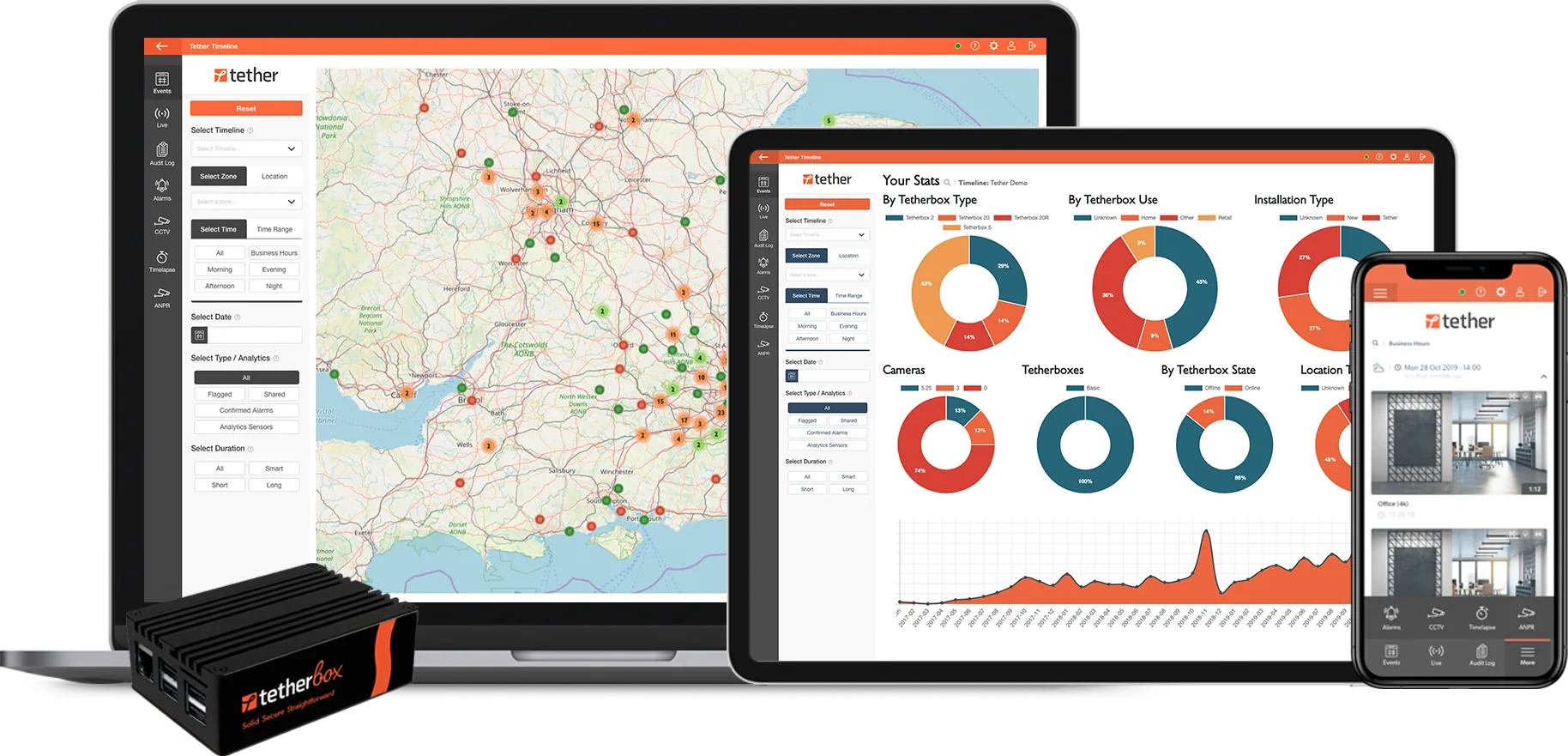
TetherBox software runs on the customer's existing server / PC at the site

Or a dedicated unit from the range - compact in-vehicle / lamp-post through to rackmount

Same platform either way - no proprietary appliance tax

Scale via storage / channel licence, not by swapping the appliance

02 · PRICING MODEL

Per-camera-per-month SKUs vs annual platform subscription

Eagle Eye / Brivo prices every camera as its own per-month SKU - resolution band x retention period x contract term - with LPR, 911 sharing and analytics as separate line items and no public price list. TetherX is one platform subscription with optional per-camera services and no resolution or retention caps.

Eagle Eye / Brivo

M10 management-only around $5/cam/mo · cloud-record tiers $15-45 · enterprise $20-50

LPR, 911 sharing and advanced analytics are separate per-camera line items on top

Every camera is its own SKU - resolution band (M10 / HD1 / HD2 / HD4 / HD10 / HD15) x retention (7 days to 5 years) x 1 / 3 / 5-yr term, e.g. HD10-D365

Higher resolution or longer retention re-prices that camera to a higher SKU - a 4K LPR cam on multi-year retention costs a large multiple of a 7-day doorway cam

No public price list - partners quote from an NDA-covered discount spreadsheet of close to a thousand SKUs, line-iteming every camera

TetherX

Annual platform subscription priced by channel count (from £100/site/year) (monthly or 1-3 yr prepay)

Optional per-camera services - cloud recording, AI, ARC monitoring - layered only where needed

No resolution cap · 4K and multi-sensor cameras supported at the platform tier

Retention set per camera, changeable any time without re-buying hardware

4K LPR on 90-day retention next to a doorway cam on 7 days, both on the same site

Recurring revenue flows through the integrator (channel-only, no direct sales)

03 · ADMIN & SCALE

Multi-site, org hierarchy, roles

Eagle Eye / Brivo has account hierarchy and roles, but the org / site / SSO features are split across the Standard / Professional / Enterprise editions. TetherX includes organisations, sub-organisations and per-role permissions natively.

Eagle Eye / Brivo

Account hierarchy is reseller-oriented - a master (reseller) account over end-user sub-accounts, built for the dealer to manage customers

Locations / Sites, Floor Plans and Smart Layouts are gated to the Professional / Enterprise editions, not the Standard edition most customers start on

SSO sits in the Professional / Enterprise editions, above the Standard edition most customers start on

Role-based permissions exist, but the richer org / sub-org modelling is an edition upsell

TetherX

Organisations + sub-organisations + per-role permissions native

Regional manager sees only their stores · national director sees everything · vendor sees high-level health stats and sites with support access enabled

Org modelling and SSO included in the platform, not gated behind a higher edition

Customer's actual org chart maps onto the platform out of the box

04 · WHO BRANDS THE DASHBOARD

Whose name is on the app and who supports the deployment

Eagle Eye / Brivo treats the installer as a reseller account under the Eagle Eye / Brivo brand. TetherX puts the qualified installer's brand on the customer's dashboard and gives them a back-office to support every site.

Eagle Eye / Brivo

Customer sees Eagle Eye / Brivo in the mobile app, login portal and every notification

Platform white-label is reserved for large OEM partners (Hanwha Wisenet SKY, Mobotix Cloud) - the installing integrator gets a reseller account under the Eagle Eye / Brivo brand, not their own

Post-merger, dealers pulled toward bundled Brivo Access + Eagle Eye Video deals

No installer-side dashboard for portfolio health, engineer scheduling or site-by-site arrival tracking

No live chat from the customer to the installer in the same app as the cameras

TetherX

Co-brand and white-label options inside the partner programme - customer sees the installer's brand on the app and portal

Sold only through qualified installers - one trained partner is the single point of contact for the customer

Installer-side dashboard with portfolio health, per-engineer breakdown, arrival-to-site tracking and a daily summary email

Customer-initiated subscription upgrades route back to the installer; customer-to-installer live chat in the same app as the cameras

06 · MULTI-SYSTEM INTEGRATION

Beyond cameras: alarms, access, serial, network

TetherX is positioned as an IoT platform for physical security, not a VSaaS bolt-on. Eagle Eye / Brivo is video-first; the merger adds access but the rest stays sparse.

Eagle Eye / Brivo

Access control limited to Brivo - the merged entity's own access product, not open to third-party access systems

No native intruder alarm panel support (serial or IP)

No serial-device integration (retail POS, solar inverters, building plant)

No SNMP wireless-AP integration or health alerts for alarm / serial / Wi-Fi

No smart-switch PoE port control from the VMS

ARC / central-station monitoring via third-party PSIM integration, not native

TetherX

Open platform - integrates any access-control system with an API, with two-way arm/disarm on entry

Native intruder alarm panels - serial and IP - alarm panel state in the dashboard

Serial-device integration for retail / solar / building plant

Wireless AP integration via SNMP with health alerts on the same screen

Smart-switch integration on any SNMP-managed switch - PoE port on/off

ARC: ARC integration across Immix, Sentinel, CONXTD, MASterMind, Bold Patriot Manitou, Stages, CHeKT and others

07 · VERTICAL SOLUTIONS & CONTROL ROOM

Packaged vertical solutions and a built-in control room

Eagle Eye / Brivo is a horizontal VMS - vertical workflows and professional monitoring come from third parties (e.g. Immix). TetherX ships packaged vertical solutions and a native control-room interface that enforces operator process.

Eagle Eye / Brivo

Horizontal VMS - no packaged vertical solution (e.g. self-storage unifying access, video, alarm and unit billing) out of the box

No native control-room / operator interface - professional monitoring routes through third-party central-station software such as Immix

Remote Video Monitoring is escalation and notification, not an operator workflow that enforces process

Vertical and monitoring workflows are partner-assembled, not a first-party solution

TetherX

Packaged vertical solutions - e.g. self-storage unifying access, video, alarm and self-storage billing in one system

Native control-room interface that enforces operator process - can run standalone inside an ARC

ARC: ARC integration across Immix, Sentinel, CONXTD, MASterMind, Bold Patriot Manitou, Stages, CHeKT and others, or run the control room yourself

One platform spans the whole vertical stack - not a VMS plus a stack of third-party tools

08 · EVIDENCE & SHARING WORKFLOW

How a clip gets out of the system

Police / insurer / loss-prevention workflow. Eagle Eye / Brivo treats sharing as a separate multi-step export. TetherX treats it as a one-click action with audit and revocation.

Eagle Eye / Brivo

Multi-step export to share a clip - download, then attach, then send

No ability to un-share a clip once it has gone out

Events arrive without context - video alone, not video + access event + LPR plate

No cloud checksum / hash on shared evidence for tamper-proof chain of custody

TetherX

One-click time-bound event sharing - secure link, expires automatically

Un-share at any time - link dies even if the recipient still has the URL

See when the shared event was viewed, by whom, and when

Events in context - video alongside the matching access-control swipe / LPR plate / alarm trip

SHA-1 cloud checksum on every export for tamper-evident chain of custody

Minute-by-minute central audit log of every view / share / configuration change

09 · OFFLINE & LOCAL OPERATION

What happens when the Internet drops

Eagle Eye / Brivo is cloud-first by architecture. TetherX keeps full live and recording at the site when the WAN is down.

Eagle Eye / Brivo

Cloud-first - if the Internet at the site drops, live view in the app drops with it

No native offline interface for site-local operation during outages

Live HD over the Internet is constrained by the Bridge uplink bandwidth

CMVR retains recording locally, but the operator workflow assumes cloud is up

TetherX

Local streaming continues over the LAN even when the WAN is down

Offline operator interface at the site - keep working through Internet outages

Up to 9 cameras at HD over the local network simultaneously, up to 32 cameras per screen total

Cloud and local are peers - cloud is for remote access, not a single point of failure

10 · CORPORATE & UX SIGNAL

Mobile apps, integration learning curve, post-merger stability

Friction installers raise repeatedly on forums and review sites.

Eagle Eye / Brivo

Three separate mobile apps - Viewer (4.2/5) · Smartphone Camera · CameraManager

End customers regularly install the wrong app

App and web-VMS quality complaints recur on review sites - reviewers say the 2025 "Enhanced Interface" redesign worsened playback, latency and stability rather than improving them

Installer forums describe the integration as "complex" - strong API, steep learning curve

29 December 2025 merger - sales-team layoffs the day after; Glassdoor under 3/5 and under 40% recommend

TetherX

One iOS app, one Android app, one web app - same login, same UI

Continuous improvements, and when a bug does surface we typically resolve it within hours, not release cycles

UK-built, founder-controlled, channel-only since day one

Integration onboarding measured in days, not weeks

Independent and founder-led - no merger overhead, no channel re-org

Pricing figures, ownership, acquisition dates and product behaviour cited on this page are point-in-time and drawn from public sources - see the disclaimer at the bottom of this page for sourcing, "as of" date, and how to flag corrections.

FAQ

Questions before you switch from Eagle Eye / Brivo

Eagle Eye / Brivo is American. Eagle Eye Networks (Austin, Texas, founded 2012 by Dean Drako, ex-CEO of Barracuda Networks) and Brivo (Bethesda, Maryland, founded 1999) merged on 29 December 2025 into a single company now branded Brivo - Dean Drako CEO, Steve Van Till President, combined revenue around $300-500M, with sales-team layoffs the day after the merger closed. Buyers look elsewhere for three reasons: high pricing, a proprietary on-site appliance at every site (the Eagle Eye Bridge or CMVR - Cloud Managed Video Recorder; the only bridgeless path is fail-prone in-camera SD cards), and a per-camera-per-month subscription where every camera is its own SKU (resolution band x retention period x contract term) with LPR, 911 sharing and analytics billed as separate line items and no public price list. The point-by-point comparison further down covers each one.

Eagle Eye / Brivo partnered with RapidSOS to share cameras directly with US 911 dispatchers - the headline US-market feature. TetherX takes a different route: verified events route to monitoring stations already running on TetherX, or partner ARCs (Immix, Sentinel, CONXTD, MASterMind, Bold Patriot Manitou, Stages, CHeKT and others), where an ARC operator verifies the incident and dispatches the emergency services. That is the standard workflow in the UK and Australia; for US 911-direct workflows TetherX connects through the ARC.

The trade publication IPVM flags an "open vs unified" risk: after the merger, Eagle Eye / Brivo dealers have an incentive to push the bundled Brivo Access + Eagle Eye Video package rather than let the installer pick the best access-control hardware for the site. TetherX already unifies cameras, alarms and access in one platform - no merger required, no bundle pull. The qualified installer picks the best access kit for each site. See the partner programme for the commercial model.

Yes. TetherX supports 1,000+ integrations and any camera that speaks ONVIF (the camera interoperability standard that lets cameras from different brands work with the same software). The overlap with Eagle Eye / Brivo's claimed 700+ is effectively complete for the cameras installers actually deploy. Existing cameras at the customer's sites stay; we add TetherX over the top via a TetherBox.

Possibly. A few well-known products share the Eagle Eye Networks platform behind a different brand. Hanwha Wisenet SKY (formerly Wisenet Cloud) is the cleanest case - the Bridge / CMVR Quickstart Guide literally says it is the Eagle Eye Networks Bridge / CMVR rebadged. The Brivo Security Suite video tier became the Eagle Eye VMS after the 29 December 2025 Brivo + Eagle Eye merger (pre-merger Brivo had its own Onair Video / Snapshot product, integrated with Eagle Eye but not an OEM rebrand). MobotixCloud is reported by integrators to run on the Eagle Eye platform as a Mobotix-branded sub-account; we can find joint integration documentation but no formal "OEM" press release, so treat that one as a strong technology partnership rather than a confirmed re-skin. If the camera brand is Hanwha but the operator app and Bridge appliance look familiar, that is why.

Yes. Drop a TetherBox at one site (software on the existing server / PC or a dedicated unit), connect the cameras, and run both platforms in parallel during the evaluation. No re-cabling, no downtime for the customer. Once TetherX is paying for itself you decommission the Eagle Eye Bridge / CMVR and the licence at that site. Phase the rollout one site at a time.

Yes. 30-day free trial through an integrator partner with a TetherBox, full platform access and a dedicated onboarding contact. Extends on request if you need more time to evaluate. No card, no commitment.

On review sites and integrator forums the recurring themes are: the 2025 "Enhanced Interface" redesign breaking playback, zoom and clip download (App Store: "no longer allows playing the videos"; G2: "slower and counter-productive due to latency"); the dashboard showing cameras offline when they are actually online, sending an engineer to site for nothing; quoting friction off a near-thousand-SKU price list (G2: "the shear amount of SKU's"); and post-merger turbulence - a 2026 subscription price rise plus partner reports of unpaid invoices and unanswered emails. TetherX's answers: automated watchdogs and continuous tests audit the online/offline status the platform reports, so the dashboard matches what is really on site; we ship improvements continuously and typically resolve bugs within hours rather than release cycles; one flat platform subscription with cloud recording optional per camera instead of a per-camera SKU matrix; and a founder-led, channel-only model with one accountable partner from quote to support.
COMPANY HISTORY

Eagle Eye Networks, Brivo and the December 2025 merger

Eagle Eye Networks was founded in 2012 in Austin, Texas by Dean Drako (the founder of Barracuda Networks). Brivo, founded in 1999 in Bethesda, Maryland, ran a parallel path on the cloud access-control side. SECOM (the Japanese security conglomerate) made a $192M joint investment across the two companies in 2023, setting up the merger.

The Eagle Eye Networks + Brivo merger closed on 29 December 2025, with the combined entity branded Brivo and Drako confirmed as CEO. Day-of-announcement sales-org consolidation removed roughly 30-40 roles. Ken Francis, the long-time Eagle Eye Networks President, had been pushed out in September 2024 ahead of the deal.

IPVM has confirmed a 2025-2026 climb in headline pricing across the combined product line, with bundle creation (Brivo Access + Eagle Eye Video) flagged as "Open Conflict" with the open-ecosystem messaging that Eagle Eye traded on pre-merger. Eagle Eye Networks held the largest market-share position in cloud VMS pre-merger; the merged Brivo entity inherits that footprint with the post-merger sales motion still bedding in. The manufacturer's site is the authoritative source for current product status.


Want this at your site?

Get a quote from a certified TetherX installer. We will match you with a local partner who knows your area and your needs.

Certified Installers
Local to You
No Obligation
Prefer to browse partners first? See our partner directory →

Still have questions about pricing, integrations or the partner programme?

Try TetherX free for 30 days

Run TetherX alongside the existing Eagle Eye / Brivo install. Trial extensions on request.

Start Free Trial

Across the partner network

TetherX partners hold the accreditations security-procurement buyers and insurers filter on. Coverage varies by partner.

NSI 9 ISO 9001 7 SSAIB 5 SafeContractor 5 BAFE 4 CHAS 4 ConstructionLine 4 Cyber Essentials 3 NICEIC 2 ISO 14001 2 ISO 27001 1

Counts reflect partners currently in the TetherX directory holding each accreditation.

Anything wrong on the Eagle Eye Networks comparison?

Flag an inaccuracy, an outdated fact, or a missing nuance on the Eagle Eye Networks page. We update the per-vendor pages and the /compare hub from this inbox - real reply, real human.

Please tell us what to call you.
Please enter your email address.
Please tell us what to fix or add.
Please complete the verification.

We reply within 1 business day. No newsletter, no follow-up sequence.

[1] About this comparison. Information about other vendors is drawn from their public product pages, datasheets, integrator forums (Reddit, vendor user groups), public CVE databases (NVD, CISA), publicly-listed LinkedIn company pages (headcount, headquarters, founding year, leadership transitions and corporate ownership signals) and customer conversations - accurate to the best of our knowledge as of Q2 2026. Pricing, features, security posture and policies change. A vendor may have shipped a fix, dropped a price, added a region or changed an architecture since this page was last reviewed.

If you believe anything here is inaccurate or out of date, please contact us and we will review and correct it. Trademarks and product names belong to their respective owners and are referenced here for identification only.

30 days free. No card. Talk to a local installer.