WHY BUYERS LEAVE VERKADA

Beautiful interface. Expensive cage.

Verkada is a polished product. The complaints aren't about pixels - they're about the business model underneath, repeated across installer forums and end-user reviews.

The 2021 breach is now a teaching example

Attackers reached roughly 150,000 cameras in 2021, inside Tesla factories, hospitals and jails, and universities have taught the incident in security courses ever since. Three years later the FTC and DOJ settled with Verkada for $2.95M over fake employee and investor reviews and CAN-SPAM violations, the largest CAN-SPAM penalty the agency has issued. A risk committee will find both, and will ask.

Every decision is made at the purchase order

Verkada sells on fixed 1, 3, 5 or 10-year terms with no month-to-month option. The retention band is chosen when the camera is bought, so moving one from 30 days to a year means buying the camera again. Then list prices rose on 5 June 2026, blamed on tariffs and AI and storage costs, with channel reports putting the band at 5-15% across 193 SKUs. Customers on the OMNIA R250206 contract hold their prices to March 2028. Everyone else meets the increase at renewal.

The cameras become scrap, not second-hand kit

A camera that will not record without an active subscription has no resale value and no fallback use. The customer bought the hardware outright, and on the day they leave it is electronic waste rather than a fleet they can redeploy or sell on. Finance notices at write-down, and so does anyone reporting on scope 3.

Five apps for the one platform

Command, Viewer, Alarms, Pass and Guest are separate downloads, and end users install the wrong one often enough that installers plan for it. The pitch is a single pane of glass; the phone tells a different story.

AT A GLANCE

Verkada and TetherX, question by question

The 8 questions an integrator asks on a site walk, answered for both platforms.

Question Verkada TetherX
What you do with the recorders already on site Replaced. Verkada cameras record to on-camera storage and the Verkada cloud, and nothing else on site is integrated - existing recorders come out. They stay. The TetherBox sits alongside the existing NVRs, DVRs and panels and pulls from them. It runs as software on a server the site already owns, so nobody rips out working kit to start.
Which devices you can connect Verkada hardware only. No ONVIF fallback and no second-source camera vendor. 1,000+ integrations across 17,000+ device models, plus any ONVIF camera with full features - not a bridged, feature-reduced tier.
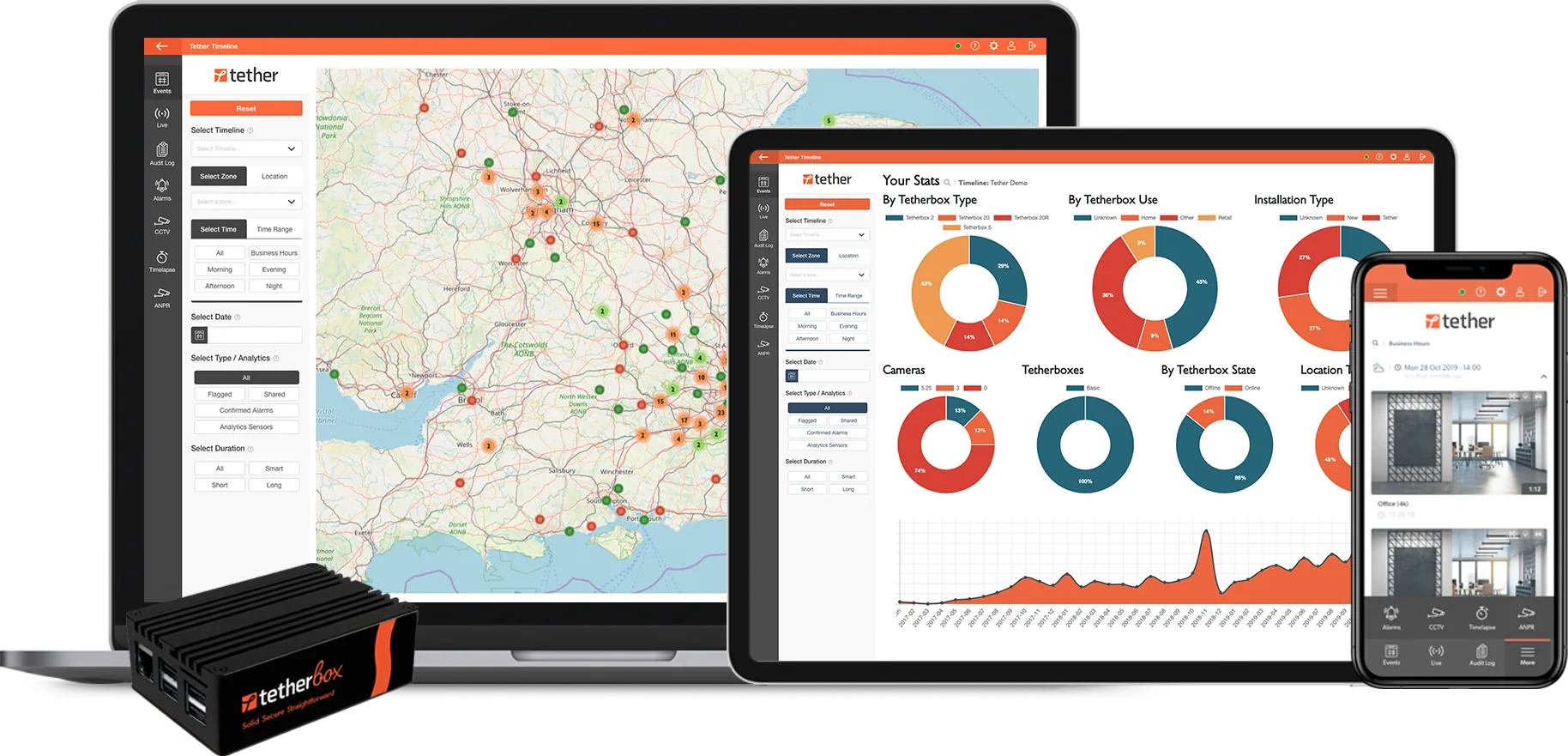
What your operators see on one timeline Cameras, access control, alarms, intercom and environmental sensors in one console, provided every part of it is Verkada. Video, access control, intruder and automation. One operator, one timeline, one dashboard across all four.
What your uplink has to carry Low in steady state. Cameras stream metadata, thumbnails and edge-AI events to Command continuously, and full-resolution clips only on demand. Thumbnails, metadata, and the clips an operator opens or chooses to sync. A thin rural line still records every camera, because recording never leaves the local network.
Where the AI runs Mature AI search across recorded footage, running on the camera silicon. Advanced analytics carry additional licence cost. At the edge on the TetherBox: person, vehicle and animal detection plus 63-class audio analytics, searchable across multi-site footage in seconds. The platform keeps evolving with additional analytics through the year.
Who you buy it from Direct sales team alongside partners. The recurring installer-forum complaint is that Verkada will sell around the installer. Your installer, always. TetherX sells through the channel only and does not quote end customers direct, so the integrator keeps the account.
What you actually pay for Cameras at $599-5,199 each plus annual licences at $199-1,799 each, on fixed 1, 3, 5 or 10-year contracts, with the retention band chosen at purchase. List prices rose on 5 June 2026. An annual subscription by channel count, from £100/site/year. Not per operator seat, not per analytic, and no concurrent-user cap.
What you keep if you stop paying The cameras stop working. No subscription, no video, and no ONVIF fallback to record them another way. The TetherBox keeps a local interface for live view and recent footage with no Internet and no subscription, so the site is never dark.

Verkada column built from: FTC settlement, September 2024, Bloomberg, 2021 camera breach, Verkada on LinkedIn.

VERKADA vs TETHERX

Closed ecosystem versus open platform.

Both unify cameras, access and alarms. The honest read on where each one wins and where each one costs you something.

Verkada

Strengths

Polished single-vendor stack - cameras, access, sensors and intercom designed together

Mature AI search across recorded footage

FedRAMP Moderate authorisation (May 2026) - federal and SLED procurement path

Trade-offs

Total camera lock-in - cameras only work with Verkada cloud and stop working if the subscription lapses

Direct-sales culture - the recurring installer-forum complaint is "sells around the installer"

TetherX

Strengths

Open to 1,000+ integrations + any ONVIF device - cameras already on site stay

Cloud recording optional per camera - local-only, cloud-only or both, all in one platform

Sold through a qualified installer - one expert partner designs, deploys and supports the system end-to-end

Trade-offs

You want one vendor to answer for everything, and lock-in is a fair price for a simpler purchase order. Verkada is the simpler buy.

BUILT FOR THE CHANNEL

One qualified installer. One expert partner.

Installer forums are full of the same Verkada quote: "They will sell around the installer, as in they have no qualms cutting you out of a deal." That's not a one-off - it's a recurring complaint across r/accesscontrol, r/techsales and other installer forums.

TetherX is sold exclusively through qualified installers. No direct sales team, no factory-direct billing, no remote sales calls bypassing the expert who designed and deployed the system. One trained, accredited partner who knows the site is the single point of contact for the customer end-to-end.

See the partner programme
TetherX channel partner programme dashboard
WHICH ONE FITS

Pick the one your site points at

Find the column that describes the job in front of you.

Choose Verkada if

  • The site is new-build with no cameras to keep, and buying hardware and platform together costs you nothing in stranded kit
  • You want a single vendor to hold the whole stack, and lock-in is an acceptable price for a simpler purchase order
  • The buyer needs FedRAMP Moderate on the procurement spec for a federal or SLED contract
  • Nobody on site will ever want a camera brand Verkada does not make

Choose TetherX if

  • The customer already owns cameras, recorders or door controllers, and replacing them all is not on the table
  • Cameras, alarms and doors need to reach one operator on one timeline across mixed vendors
  • The customer wants to keep recording locally and decide camera by camera what goes to the cloud
  • The installer needs to stay the account owner, not become optional once the vendor knows the customer
FAQ

Questions before you switch from Verkada

Verkada is American (San Mateo, California, founded 2016), venture-backed by Sequoia, Felicis and Meritech. A CapitalG-led round on 3 December 2025 lifted the valuation to US$5.8B on 31,000 customers and +30% year-on-year revenue. The IPO remains delayed, and the trade publication IPVM covered internal employee frustration about it in March 2026.

Buyers leave for three reasons, and the table above covers the first two: the cameras only work with Verkada cloud, and the money keeps going out for as long as they do. The third is cultural. Installers describe the direct-sales motion as selling around them, and it is the complaint that comes up most in their own forums rather than in end-user reviews.

Verkada answers the security question with FedRAMP Moderate authorisation, granted on 14 May 2026, and that is a genuine federal and SLED procurement path a challenger cannot match. It sits alongside the breach and the settlement rather than closing them.

Yes. TetherX supports 1,000+ integrations plus any ONVIF (the camera interoperability standard that lets cameras from different brands work with the same software) device - Hanwha, Axis, Bosch, Hikvision, Dahua, Uniview, i-Pro, Avigilon and the rest. The cameras already installed at the customer site stay. No rip-and-replace, no proprietary hardware, no per-camera annual licence on top of the device cost.

A TetherBox at every site bridges the cameras to the cloud over an outbound-only encrypted tunnel - cameras never touch the Internet directly. Open at the edge, ringfenced at the boundary.

A ten-camera mid-market project lands somewhere between US$10,000 and $25,000 in year one, before any storage upgrade. The customer renews the licence after that, or the cameras go dark. Verkada built those per-camera economics around large accounts and does not soften them for small ones, which is why small-business installers routinely lose the customer before finishing the demo. Verkada published its 2026 Pricing Update on 5 June 2026.

TetherX is an annual subscription priced by channel count (from £100/site/year) through your installer - dashboard, multi-site, alarms and access included - with cloud recording, AI search and ARC monitoring added per camera only where the customer wants them. No hardware floor, no licence cliff at renewal, no stranded cameras if the customer ever moves off.

Try it on your own kit first with a 30-day free trial - extensions available on request if the evaluation needs more time.

It is, and the reputation is earned. The catch is where it runs: Verkada's analytics live on Verkada camera silicon, so the search is only as complete as the fleet is Verkada, and a mixed site ends up with two search tools or a replacement programme.

TetherX AI runs on the TetherBox instead, so one search covers a camera bought in 2018 and one bought next year, whoever made either. The table above lists what it detects.

Yes. TetherX is sold exclusively through qualified installers - we never sell direct. The qualified installer who designed and deployed the system stays the single point of contact for the customer. The "sells around the installer" pattern that installers cite repeatedly as a reason to avoid Verkada can't happen with TetherX by design. See the Partner Programme for the commercial model.

TetherX already unifies cameras, alarms and access control in one dashboard - the same idea as Verkada. The difference is the hardware underneath. With TetherX the installer picks the cameras and the access control, rather than being locked to one vendor for the whole stack.

For monitored sites, ARC integration connects directly into ARC (Alarm Receiving Centre) workflows without forcing the end customer into a single-vendor responder app.

The Command Connector (CC700-F) is Verkada's official way to bring an ONVIF camera into Command. List price US$9,599 per appliance, capped at 50 channels, capped at 30 days of retention, and you still pay a per-channel cloud-management licence on top. IPVM and installers describe it as a stopgap fix for retrofits, not a real strategy.

TetherX does the same job natively. A TetherBox at the site already speaks ONVIF and 1,000+ integration protocols - no separate appliance SKU, no 50-channel cap, retention set per-camera and changeable any time. Multi-vendor is the default, not the exception.

TetherX takes a ringfencing-first approach: existing cameras stay behind the TetherBox, which is the only thing that talks to the cloud. Where regulations (NDAA Section 889 in the US, UK high-secure guidance, Australia's PSPF) require approved manufacturers, the platform supports phased camera replacement over 12-36 months without forcing a single-vendor swap. Read the full compliance and ringfencing page for the shared-responsibility model.

COMPANY HISTORY

Verkada: founding, breach, FTC settlement and IPO track

Verkada was founded in San Mateo, California in 2016, with the closed-cloud single-vendor camera + access + sensors + intercom stack as the original product thesis. Last private valuation $3.2B, with the company on a public-IPO track as of 2025-26.

The 2021 breach exposed video from approximately 150,000 cameras (Tesla, jails, hospitals) and is now permanently referenced in cybersecurity case studies. In September 2024 the FTC and DOJ reached a $2.95M settlement with Verkada over fake employee and investor reviews and CAN-SPAM Act violations - the largest CAN-SPAM penalty the FTC has issued.

Verkada achieved FedRAMP Moderate authorisation on 14 May 2026, opening federal / SLED procurement paths. List-price increases effective 5 June 2026 were announced shortly after, blamed on AI / memory / storage costs and tariffs - channel rumour puts the increase band at 5-15% across the 193-SKU catalogue. OMNIA R250206-pricing customers are contractually protected through March 2028; other customers get repriced upwards on the next quote. The manufacturer's site is the authoritative source for current product status.


Free comparison PDF

Not ready to talk? Take the comparison with you.

A one-page open cloud VMS versus locked-platform breakdown: what you keep, what you cut, what it costs. We will email it over, usually the same working day.

Please complete the verification.

No sales call; your details stay with us. We route serious enquiries through accredited local TetherX installers.

Want this at your site?

Get a quote from a certified TetherX installer. We will match you with a local partner who knows your area and your needs.

Certified Installers
Local to You
No Obligation
Prefer to browse partners first? See our partner directory →

Still have questions about pricing, supported cameras, the partner programme or AI search?

Try TetherX free for 30 days

Use your existing cameras. Keep the customer. See how an open platform feels next to a closed one. Trial extensions on request.

Start Free Trial

Across the partner network

TetherX partners hold the accreditations security-procurement buyers and insurers filter on. Coverage varies by partner.

NSI 9 ISO 9001 7 SSAIB 5 SafeContractor 5 BAFE 4 CHAS 4 ConstructionLine 4 Cyber Essentials 3 NICEIC 2 ISO 14001 2 ISO 27001 1

Counts reflect partners currently in the TetherX directory holding each accreditation.

Anything wrong on the Verkada comparison?

Flag an inaccuracy, an outdated fact, or a missing nuance on the Verkada page. We update the per-vendor pages and the /compare hub from this inbox - real reply, real human.

Please tell us what to call you.
Please enter your email address.
Please tell us what to fix or add.
Please complete the verification.

We reply within 1 business day. No newsletter, no follow-up sequence.

[1] About this comparison. Information about other vendors is drawn from their public product pages, datasheets, integrator forums (Reddit, vendor user groups), public CVE databases (NVD, CISA), publicly-listed LinkedIn company pages (headcount, headquarters, founding year, leadership transitions and corporate ownership signals) and customer conversations - accurate to the best of our knowledge as of Q2 2026. Pricing, features, security posture and policies change. A vendor may have shipped a fix, dropped a price, added a region or changed an architecture since this page was last reviewed.

If you believe anything here is inaccurate or out of date, please contact us and we will review and correct it. Trademarks and product names belong to their respective owners and are referenced here for identification only.

30 days free. No card. Talk to a local installer.