VSaaS vs NVR / DVR
Local box - or cloud-managed across every site?
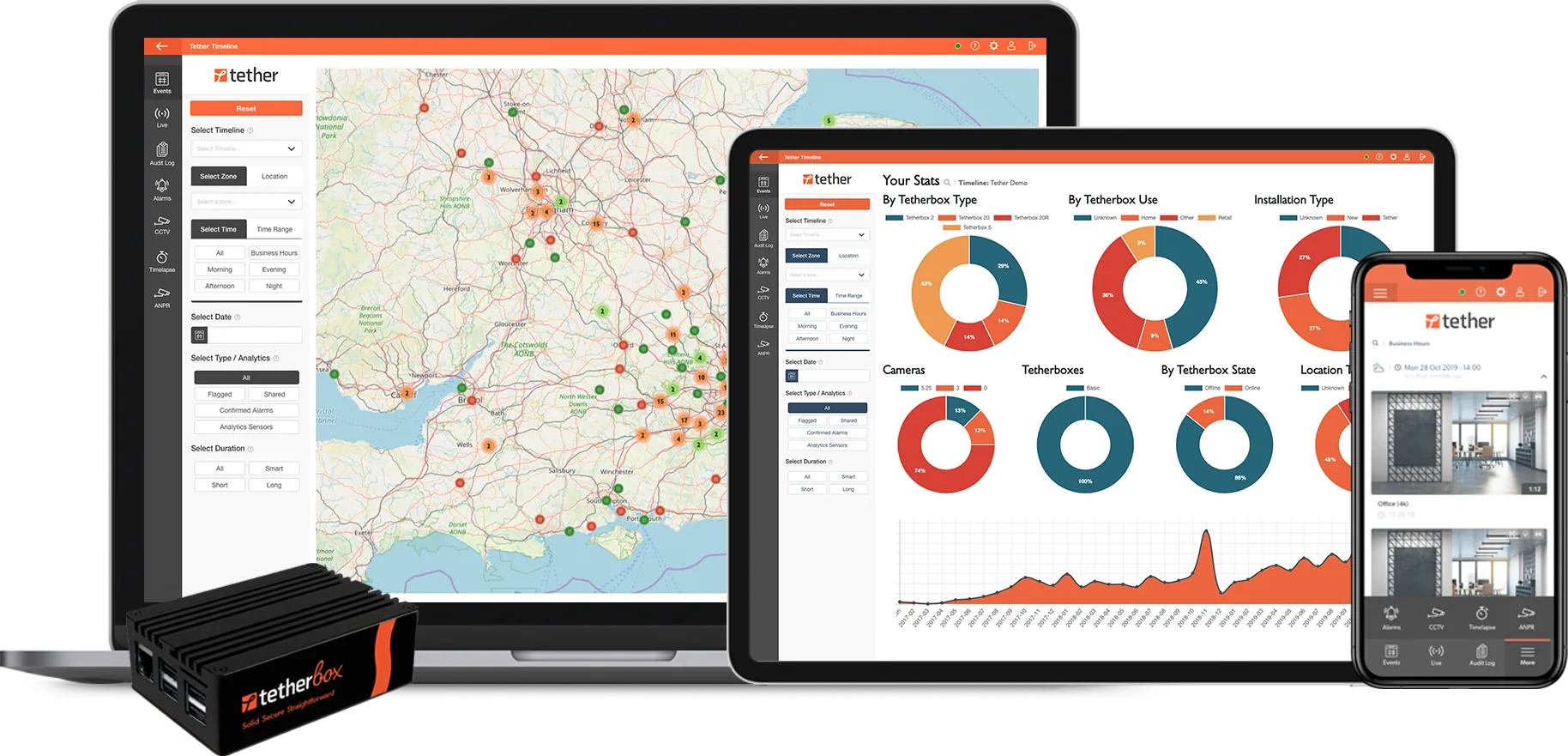
An NVR records IP cameras at one site - Hikvision DS-7600 (Chinese), Dahua NVR4000 (Chinese), Uniview NVR301 (Chinese), Avigilon HD NVR (Canadian, Motorola), Bosch DIVAR IP (German), Milestone Husky (Danish, Canon). VSaaS manages cameras across many sites from the cloud. The common-sense 2026 fit for many deployments is hybrid: a TetherBox at each site for resilience, the cloud for management. Here's when each wins.
TetherX: Built in the UK and Australia. Local representatives in Canada and India. EU, North America and APAC supported.
Six reasons multi-site customers move off pure-NVR setups.
Port-forward for remote view
Every NVR that needs remote access opens an inbound port through the firewall. After a ransomware incident, corporate IT typically requires "no inbound ports" - the NVR fails that policy.
NVR security track record is poor
IPVM disclosed 12 CVEs (security bugs) in Dahua DSS (Chinese) in January 2023 alone, affecting around 3,100 Internet-exposed servers. Hikvision iVMS-4200 (Chinese) has shipped plain-text passwords in dealer communications. Hik-Connect is treated as a botnet recruitment risk by parts of the installer community.
Multi-site is painful
20 sites = 20 NVRs = 20 firewall setups, 20 sets of credentials, 20 firmware-upgrade visits. VPN concentrators help but don't fix the operating overhead.
NDAA-banned hardware
Hikvision and Dahua NVRs are banned for US federal-adjacent buyers under NDAA Section 889 (the US trade rule on Chinese cameras). Canada's ban became official in 2025. UK and Australia restrict government sites. Migrating off these NVRs is the slow and expensive part.
Hardware refresh every 3-5 years
NVR appliances age out. Firmware support drops. The customer pays for replacement on a cycle the installer rarely sees coming.
No cross-site search
Need to find a vehicle that visited three sites? Pure NVR means three separate searches and three separate exports. Cloud VSaaS searches all sites at once.
Two recording paradigms. One usually beats the other beyond a single site.
A box ages out. A software platform compounds. why software-first beats hardware-first covers the long version. The honest read on where each one wins and where each one costs you something.
Standalone NVR / DVR
Strengths
One-off capital purchase, no ongoing subscription line - everything records locally to disks the customer owns outright
Genuinely the simpler answer for a single-site, single-brand deployment with no remote-access or multi-site requirement
Predictable storage cost at scale - 90 days of continuous 4MP video on local disks is materially cheaper than the equivalent in cloud storage
Trade-offs
The box is what ages - firmware support drops after a few years, the unpatched recorder becomes the soft spot in the network, and the customer pays for a hardware refresh every 3-5 years
Single-vendor catalogue: the recorder only knows the cameras and integrations its manufacturer ships, multi-site needs one firewall + VPN + firmware visit per site, and inbound-port remote view fails the corporate-IT no-inbound-ports baseline
TetherX hybrid VSaaS
Strengths
Software-first platform - over-the-air updates land on every TetherBox in the field, a unit deployed years ago runs the exact same latest software as one activated this morning, and every new camera or alarm-panel integration arrives in the same update
TetherBox records locally at the site (days to months of retention) and syncs to the cloud on demand - outbound-only encrypted tunnel, no inbound ports, one console for unlimited sites and 1,000+ integrations
Keep existing Hikvision and Dahua cameras ringfenced behind the TetherBox while phased replacement runs over 12-36 months where the rules require it; cross-site search and AI search across the whole estate
Trade-offs
If the customer has one site, one camera brand, no remote-access need and no plan to add anything, a standalone NVR is the simpler one-off purchase
Pricing figures, ownership, acquisition dates and product behaviour cited on this page are point-in-time and drawn from public sources - see the disclaimer at the bottom of this page for sourcing, "as of" date, and how to flag corrections.
Questions before you move from NVR to cloud VSaaS
DVR (Digital Video Recorder): records analogue cameras at one site. Mostly legacy in 2026 - everything new is IP.
NVR (Network Video Recorder): records IP cameras at one site. Examples: Hikvision DS-7600 series (Chinese), Dahua NVR4000 series (Chinese), Uniview NVR301 (Chinese), Avigilon HD NVR (Canadian, Motorola Solutions American), Bosch DIVAR IP (German, now Triton/Keenfinity), Milestone Husky X2/X8 (Danish, Canon).
VSaaS (Video Surveillance as a Service): cloud-managed CCTV across many sites. The recording lives in the vendor's cloud (Verkada American, Rhombus American), at the edge plus the cloud (TetherX UK + AU via TetherBox, Eagle Eye / Brivo American via Bridge, Videoloft British via Cloud Adapter), or in an existing on-site NVR that an adapter pushes to the cloud (Camcloud Canadian).
Two real reasons. Bandwidth: 30 cameras at 4MP each uses roughly 60-120 Mbps of continuous upload. Many sites don't have it. Storage cost: keeping 90 days of 4MP continuous video for 30 cameras in someone else's cloud is materially more expensive than on a $1,500 NVR with $300 of disks.
One thing buyers get wrong: chain of custody is actually a cloud strength, not an NVR one. Footage on a local NVR can be edited, deleted or replaced on the recorder itself; TetherX generates a SHA-1 checksum (a tamper-detection fingerprint) for every minute of recording at the time it's written, so any later edit is detectable on export. A "local recorder hash" only proves the file matches the local recorder - which is the device an attacker would control.
The common-sense 2026 fit for many sites is hybrid: a small on-site box (TetherBox, Eagle Eye Bridge, Milestone Husky) records locally for bandwidth and storage efficiency, while the cloud provides the tamper-evident hash, audit trail and time-bound sharing the local recorder can't.
Bad. In January 2023 the trade publication IPVM disclosed 12 CVEs (Common Vulnerabilities and Exposures - the public security-bug catalogue) in Dahua DSS, affecting around 3,100 Internet-exposed servers. Hikvision's iVMS-4200 has a long history of plain-text passwords in dealer communications. Hik-Connect (the Hikvision remote-access cloud) is treated as a botnet recruitment risk by some installers. Every NVR that needs remote access requires an inbound port through the firewall - the exact configuration ransomware attackers look for.
One installer in IPVM's 2025 survey of 120 installers put it like this: "EagleEye cloud because a major client had a ransomware attack and their corporate IT dept mandated a no open port policy. Cloud was the solution to meet this requirement." That same conversation drives nearly every NVR-to-cloud migration.
Hardware NVR: $1,000-3,000 box + $300-800 of disks + £0/month subscription + Internet for remote access (via port-forwarding). Plus replacement every 3-5 years when the appliance ages out, the manufacturer drops firmware support, or the customer adds sites.
Pure cloud VSaaS (Verkada and Rhombus, both American): $99-1,799/cam/year licence depending on tier, plus the camera hardware. At 16 cameras over 5 years that's materially more than the NVR even before storage tier upgrades.
Hybrid VSaaS (TetherX with TetherBox, or Eagle Eye Bridge): annual subscription priced by channel count (from £100/site/year), a TetherBox at each site for local resilience, the cloud only for what needs it. Usually beats both pure cloud at scale and pure NVR on running cost from year 2 onwards because the multi-site management overhead disappears.
Yes, two ways. Cloud adapter (Videoloft British, Camcloud Canadian) pushes streams from an existing recorder up to AWS. Cheapest retrofit. Inherits whatever limitations the underlying NVR has. Hybrid VSaaS overlay (TetherX with TetherBox alongside the NVR) takes the cameras under TetherX management while the NVR keeps recording locally as a backup. Same cameras, two recording paths, one multi-site cloud dashboard.
The free Hikvision iVMS-4200, Dahua DSS Express and Uniview EZStation tools hit walls fast: Windows-only, single-brand, no real cloud, port-forwarding for remote view, a ceiling around 64-256 cameras per server. Most installers outgrow them by the second multi-site customer. TetherX is the installer-channel path off them - keep the existing Hikvision and Dahua cameras at first, retire the free desktop tool, manage everything through the cloud. See iVMS / DSS / EZStation alternative for the full migration plan and NDAA compliance and ringfencing for the NDAA implications.
Yes. Cameras never touch the public Internet directly. The TetherBox is the only thing that talks to TetherX cloud, over an outbound-only encrypted tunnel. Two paths to the same architecture: TetherBox software on an existing server or PC already at the site, or a dedicated unit from the TetherBox range (compact in-vehicle and lamp-post models through to rackmount servers for sites recording hundreds of cameras with long local retention).
Yes. 30-day free trial through an integrator partner with a TetherBox, full platform access, and a dedicated onboarding contact. Run alongside the existing NVR for comparison. No card, no commitment. Extensions on request.
Free comparison PDF
Not ready to talk? Take the comparison with you.
A one-page open cloud VMS versus locked-platform breakdown: what you keep, what you cut, what it costs. We will email it over, usually the same working day.
No sales call; your details stay with us. We route serious enquiries through accredited local TetherX installers.
Want this at your site?
Get a quote from a certified TetherX installer. We will match you with a local partner who knows your area and your needs.

Need a 5-year TCO worked example for a specific multi-site retrofit off Hikvision NVR / DSS / iVMS?
Try TetherX free for 30 days
Run TetherX over the existing NVR estate for a 30-day trial - keep the cameras and the recorder, add cloud management over the top. No rip-and-replace, no card.
Start Free TrialAcross the partner network
TetherX partners hold the accreditations security-procurement buyers and insurers filter on. Coverage varies by partner.
Counts reflect partners currently in the TetherX directory holding each accreditation.
Anything wrong on the VSaaS vs NVR / DVR comparison?
Flag an inaccuracy, an outdated fact, or a missing nuance on the VSaaS vs NVR / DVR page. We update the per-vendor pages and the /compare hub from this inbox - real reply, real human.
[1] About this comparison. Information about other vendors is drawn from their public product pages, datasheets, integrator forums (Reddit, vendor user groups), public CVE databases (NVD, CISA), publicly-listed LinkedIn company pages (headcount, headquarters, founding year, leadership transitions and corporate ownership signals) and customer conversations - accurate to the best of our knowledge as of Q2 2026. Pricing, features, security posture and policies change. A vendor may have shipped a fix, dropped a price, added a region or changed an architecture since this page was last reviewed.
If you believe anything here is inaccurate or out of date, please contact us and we will review and correct it. Trademarks and product names belong to their respective owners and are referenced here for identification only.
30 days free. No card. Talk to a local installer.
