
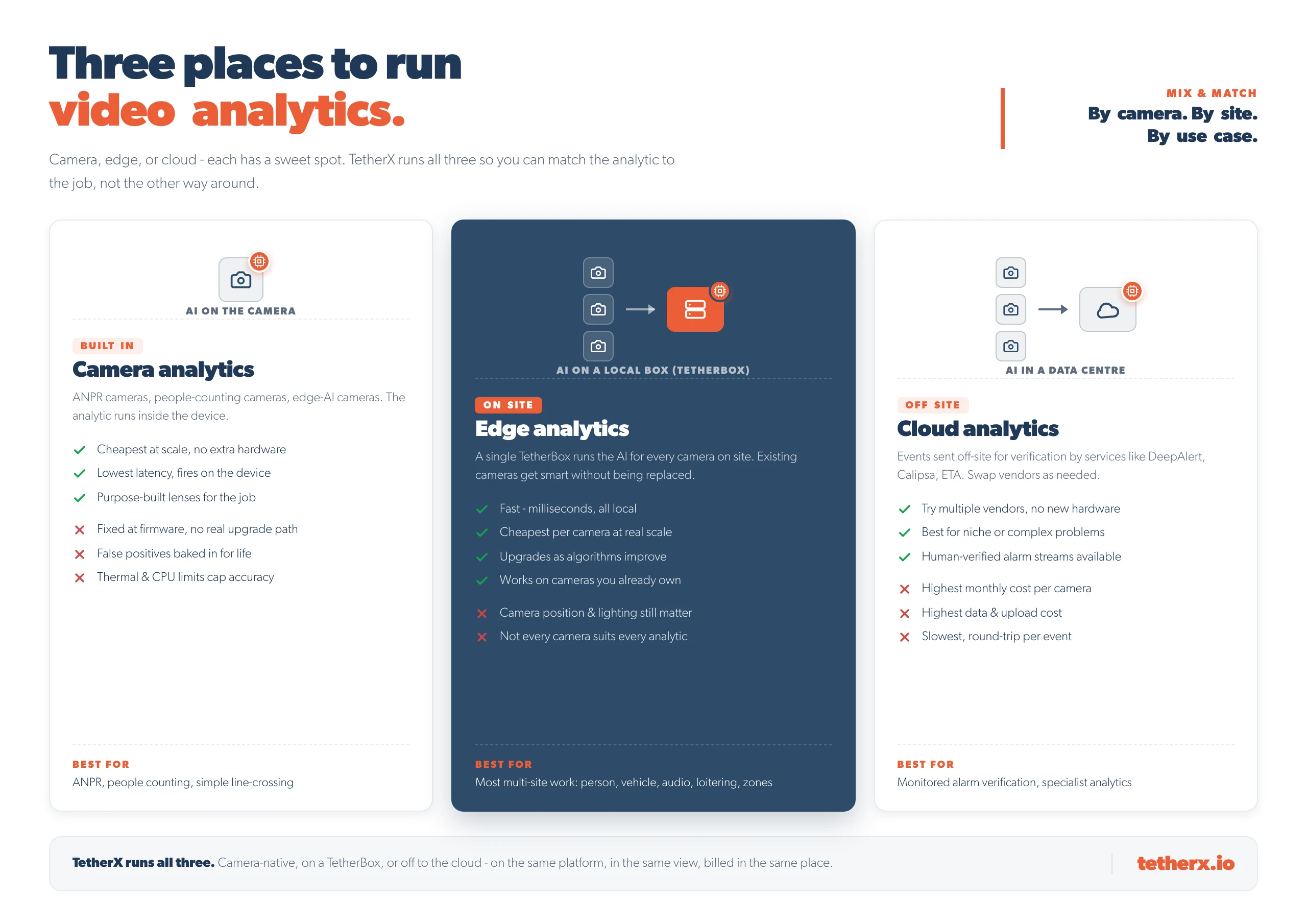
The three places video analytics can actually run. Each has a sweet spot. TetherX runs all three on the same platform, in the same view.
Video analytics is one of those topics where the marketing has flattened a real engineering decision into a single category. There are at least three different places the analysis can happen, each with very different cost, latency, and accuracy properties. Pick the wrong one for the job and you either overpay forever or get results you can't trust.
Here is the honest breakdown.
Camera Analytics - "Built In"
The camera itself does the analysis. ANPR cameras, people-counting cameras, edge-AI cameras with built-in person and vehicle detection. The processing chip sits next to the lens.
What it's good for
- Cheapest at scale. No extra hardware to buy or maintain. The analytic is part of the camera price.
- Lowest latency. The detection fires inside the device. No network hop.
- Purpose-built optics. A good ANPR camera has a lens, shutter, and IR profile tuned for reading plates at speed in any light. A good people-counting camera often has two lenses to avoid double-counting overlapping bodies. You cannot replicate that with software.
Where it falls down
- Fixed at firmware. The algorithm shipped on day one is mostly the algorithm you'll have on day 2,000. Firmware updates rarely add or meaningfully improve analytic capabilities.
- False positives are baked in. If the camera throws three false person-detections every day, that is unlikely to ever be fixed - and you cannot move to a better algorithm without replacing the hardware.
- Thermal and CPU limits cap accuracy. A camera is a small sealed box. There is only so much compute you can run in there without it cooking itself. Modern AI models have outgrown what camera processors can run.
Best for: ANPR, people counting, simple line-crossing, any well-bounded task where the optics matter more than the algorithm.
Edge Analytics - "On Site"
A local box on the site - in our world a TetherBox running TetherX AI, Aimetis Symphony, or another edge engine - runs the analytics for the cameras attached to it. Existing cameras get smarter without being replaced.
What it's good for
- Fast. Detection happens in milliseconds on the local network. No round-trip.
- Cheapest per camera at real scale. One reasonably specced box handles dozens of cameras. The per-camera cost falls fast.
- Upgradable. New models, better algorithms, additional analytics - all land as a software update. The cameras stay where they are.
- Hardware-agnostic. Works on the cameras you already own across 1,000+ integrations. The old fleet gets the new brain.
Where it falls down
- Camera position and lighting still matter. Edge AI is good, but it can't fix a camera pointed at the wrong place. A car park camera at the wrong height will still miss plates at night.
- Not every camera suits every analytic. A 360-degree fisheye is not a great ANPR camera even with the best software in the world. Some jobs still want purpose-built optics.
Best for: most multi-site work - person and vehicle detection, audio AI, loitering, zone intrusion, line crossing across an entire estate.
This is where most analytics workload should sit by default.
Cloud Analytics - "Off Site"
Events get sent off-site - to services like DeepAlert, Calipsa, or ETA - for analysis or human verification. Particularly common in monitored alarm verification, where a human operator confirms an alarm is real before dispatch.
What it's good for
- Vendor flexibility. Want to A/B two different cloud verifiers? No new hardware required, just point the events at a different endpoint.
- Niche and complex problems. Some analytics are genuinely hard and best left to specialists. Behavioural analysis, complex scene understanding, vendor-specific algorithms that simply don't run on the edge yet.
- Human-in-the-loop alarm verification. A trained operator looking at every alarm before it goes to dispatch is a service that fundamentally lives in the cloud.
Where it falls down
- Highest cost per camera. You're paying a monthly per-camera or per-event fee on top of your platform cost.
- Highest data cost. Every event being verified means images going up - bandwidth and storage charges follow.
- Slowest. A round trip to a verifier, even a fast one, adds seconds. For alarm verification that is fine. For door-open triggers it is not.
Best for: monitored alarm verification, specialist analytics, and any problem you want to evaluate across multiple vendors without committing to hardware.
The Honest Default
For most multi-site deployments, edge wins for most of the workload. Camera-native handles the analytics where the optics matter more than the algorithm. Cloud handles the verification and the niche stuff.
The combination is far cheaper, faster, and more accurate than picking any one of them and forcing it to do everything.
Why It Matters That You Can Mix
The trap most platforms fall into is forcing one approach. A cloud-only VMS makes you pay cloud prices on every motion event from every car park camera, forever. A camera-only setup leaves you stuck with whatever analytic shipped in the box. An edge-only platform may not give you the cloud-verification option some insurers and ARCs now require.
TetherX runs all three on the same platform, in the same view, billed in the same place. You can have a TetherBox doing edge person detection on twenty cameras, a couple of ANPR cameras feeding the same incidents view via their built-in analytics, and a cloud verifier wrapped around the perimeter cameras at night. All triggers land in the same timeline, all clips are stored together, and the operator does not need to know or care which brain made the call.
That is the right answer for most multi-site work. It also means you are never locked into a single vendor's analytics roadmap.
Describe the Footage, Then Review the Filters
Natural language footage search works across the supported detections those sources record. Ask for “line crossing last Tuesday” or “a person wearing a red hat at the front door”, review the selected filters, adjust the dates and apply the search. Combine clothing, hat, vehicle and animal colours with the sites and times you need.
The cloud turns your description into search filters, while the detection can run on the camera, at the edge or through a cloud service. Review the proposed filters and dates, then open the matching events across your sites.
For the wider context, see why software beats hardware, the timeline never goes blank on continuous coverage, and why integrators choose TetherX.
Trial the full platform free for 30 days on hardware you already own. No commitment, no kit to send back.

Leave a Comment