
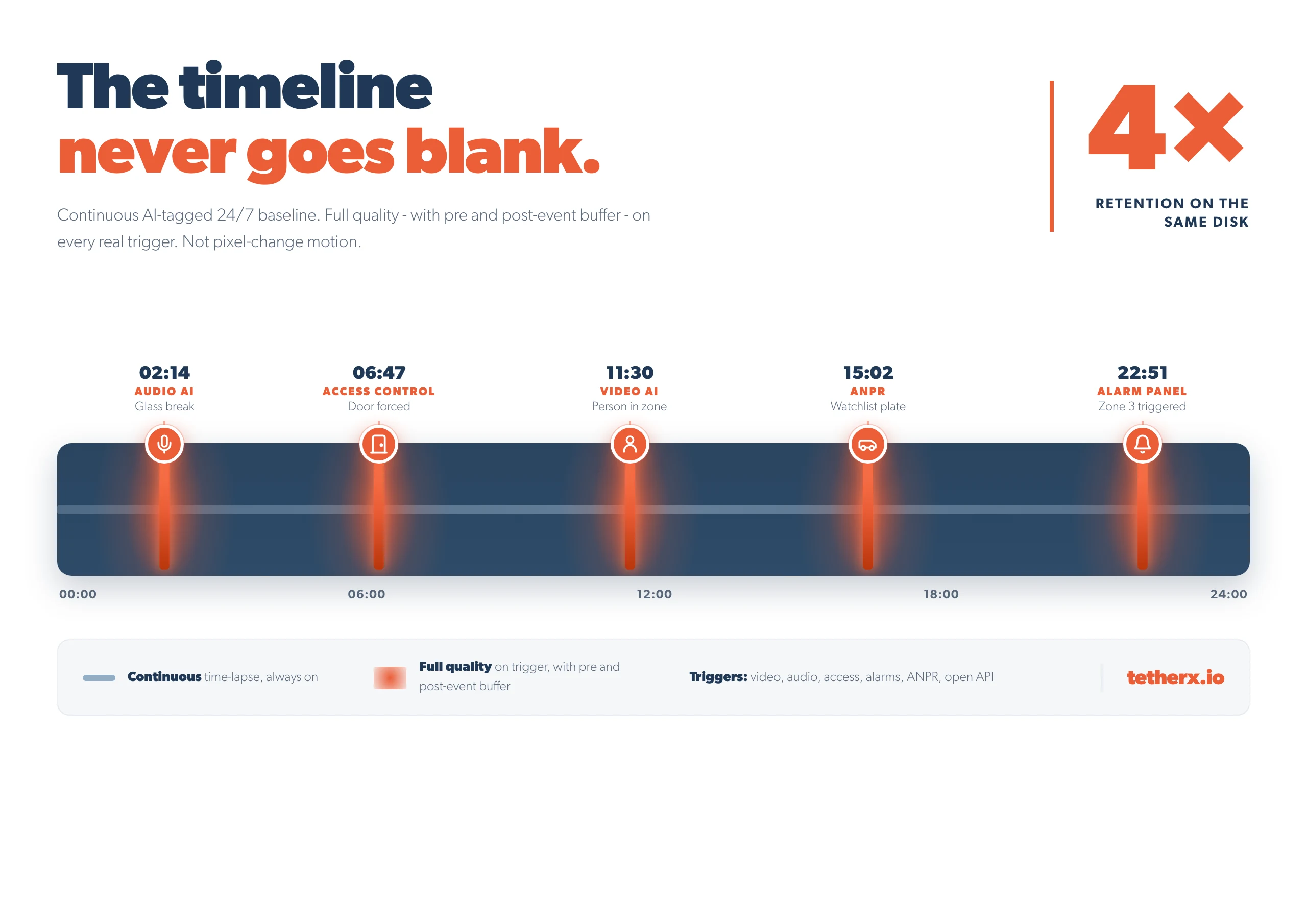
A typical 24 hour window on TetherX. A continuous, AI-tagged baseline runs the whole day. Full-quality bursts kick in on real triggers - audio AI glass break, access control door forced, video AI person in zone, ANPR watchlist hit, alarm panel zone.
The Problem With "Motion-Based" Recording
Most CCTV is either constantly recording at full quality - chewing through storage in days - or it is motion-based, which means it stops recording the moment nothing in the frame is moving.
Motion-based sounds clever until you actually need the footage. The person who stood still behind a parked van. The intruder who walked in slowly enough that the algorithm did not classify it as motion. The shoplifter who blends into a busy aisle. The car that pulled up, sat for ten minutes, then drove off. Pixel-change motion detection cannot tell the difference between any of these and a quiet scene.
And the bigger gap: a customer asks you to prove no one was on site at 2am. With motion-based recording, the right answer is "I do not have any footage for that window, because nothing triggered". That is not evidence of absence. That is just absence of evidence.
The TetherX Default Is Continuous, Smart, and AI-Aware
We do not stop recording when nothing moves. We never have. Every camera on TetherX keeps a continuous 24/7 baseline that runs at a low bitrate - a best-frame every few seconds, tagged in real time by the video AI.
That baseline is small enough to store cheaply for months, but rich enough to answer the questions you actually get asked.
- Was anyone there at 2am? Open the timeline. Scrub the empty corridor frame-by-frame at 5 second intervals. Empty in every frame, every minute, for the whole night. That is real, time-stamped evidence of absence.
- Did someone walk past at 02:14? The video AI tagged them in the baseline. The bounding box is on the frame. They are front and centre, automatically, even at the low-bitrate baseline rate.
- Was the back door propped open between 14:00 and 16:00? The baseline shows the door, every few seconds, all afternoon. The change is obvious from the time-lapse alone.
The timeline is never blank. The footage is small, but the answers are there.
Real Triggers Switch to Full Quality
The smart part is that we do not need motion in the frame to escalate. Triggers come from anywhere on the platform.
- Video AI - person, vehicle, loitering, line crossing, zone intrusion. Not pixel-change. Object detection, classification, scene understanding.
- Audio AI - glass break, raised voice, alarm tone, gunshot.
- Access control - door forced, door held open, swipe at an unusual hour, duress code entered.
- Alarm panel - any zone triggered, panel armed, panic button.
- ANPR - watchlist hit on a perimeter camera.
- Open API - anything you can push through a webhook. Building management. Workforce management. Custom integration.
When any of these fires, every nearby camera switches to full bitrate, full framerate, and keeps the seconds before the trigger as well as the seconds after. The pre-event window matters: the run-up to most incidents is the bit that actually tells you what happened.
A camera that sees a person standing perfectly still in frame also keeps recording at full quality, because the video AI keeps detecting them. There is no scenario where someone visible to the camera causes recording to stop.
The Result
Same disk, same cameras, far longer retention than constant full-quality recording. A continuous, AI-tagged timeline you can scrub for any moment of any day. Full-quality, pre-and-post-event clips for every real incident, triggered by something more meaningful than pixels changing colour.
You can prove nothing happened. You can prove everything that did. And the storage bill stops being the conversation.
Two Questions Worth Asking Your Current Vendor
- If nothing moves in the frame, are you still recording, or does the timeline go blank?
- When a trigger fires, what fires it - actual events like audio, access, AI detections, alarm zones, or just pixels changing?
If the answers are "the timeline goes blank" and "pixels changing", that is the gap worth closing.
TetherX is hardware-agnostic across 1,000+ integrations, runs on whatever recorder you can source today, and ships with multi-year licensing for budget predictability. For the wider context, why software beats hardware and why integrators choose TetherX.
Trial the full platform free for 30 days on hardware you already own. No commitment, no kit to send back.

Leave a Comment